
 Shop
 My
 Custom





Free Printable: Low Carb & Keto Food List
Get It NowBefore you start converting sweeteners, read my guide about sugar substitutes and keto sweeteners here — it’s crucial for understanding how they work and has a big section on baking. The most common question I get, though, is how to replace sweeteners in keto recipes. So, I created a sweetener conversion chart, as well as an easy calculator to do it for you. I’ll also talk about erythritol substitutes (the most common question), and the recipe differences when using erythritol vs stevia, monk fruit vs stevia, and allulose vs erythritol.
If you’re overwhelmed about which keto sweetener to try first, I highly recommend starting with Besti Monk Fruit Sweetener With Allulose! It tastes and bakes just like sugar, but unlike other brands of monk fruit, it also dissolves and browns like sugar as well. It’s great for a keto diet and you don’t have to sacrifice taste.
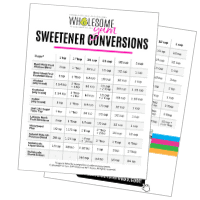
FREE PRINTABLE: SWEETENER CONVERSION CHART
Join 300,000+ others to get a FREE printable conversion chart for keto sweeteners!
GET IT NOWHow To Substitute Sweeteners In Recipes

If you need to replace a sugar-free sweetener, try to replace it with one that has a similar volume and sweetness level, and the same type (liquid, granulated, or powdered). This is the safest way to get a positive end result. Use the sweetener conversion chart or calculator below for the exact amount.
If you can’t, the way to do it will vary depending on the recipe. Here are some general tips:
- To replace a granulated sweetener with a concentrated one, replace that bulk with something else. If you are baking, this would be whatever flour the recipe uses. As long as that flour is not drying (like coconut flour), it should turn out okay. But, you will likely need a little more of the converted amount of concentrated sweetener, to account for the extra (not sweet) flour. If the flour is drying, like coconut flour, you’ll need more liquid as well to compensate.
- To replace a granulated sweetener with a liquid one, add more of the dry ingredients in the recipe to absorb the extra liquid.
- To replace a concentrated sweetener with a granulated one, add more of the wet ingredients in the recipe to balance out the extra bulk from the granulated sweetener.
- Check the section on baking with erythritol for more tips.
Are you seeing the pattern? There are no guarantees when replacing sweeteners of different types. These tips are a guideline, but not guaranteed to work. At least this should give you a general idea.
You want to try to maintain the same consistency of the batter or dough that you are working with, while keeping a similar level of sweetness. It’s not always easy!

Natural Keto Sweetener Conversion Chart
There are various sources out there for converting among sugar-free sweeteners. The problem is that I have yet to see a chart that lists many or most of them in one place, in a concise way. I put together a chart that you can use as your go-to place for sweetener conversion.
Want a printable version of the sugar-free sweetener conversion chart? Sign up below and I’ll send it to you!
FREE PRINTABLE: SWEETENER CONVERSION CHART
Join 300,000+ others to get a FREE printable conversion chart for keto sweeteners!
GET IT NOW| Sugar | 1 tsp | 1 Tbsp | 1/4 cup | 1/3 cup | 1/2 cup | 1 cup |
|---|---|---|---|---|---|---|
| Besti Monk Fruit Allulose Blend | 1 tsp | 1 Tbsp | 1/4 cup | 1/3 cup | 1/2 cup | 1 cup |
| Wholesome Yum Allulose | 1 1/4 tsp | 1 Tbsp + 1 tsp | 1/3 cup | 1/3 cup + 2 Tbsp | 2/3 cup | 1 1/3 cup |
| Erythritol (any brand) | 1 1/4 tsp | 1 Tbsp + 1 tsp | 1/3 cup | 1/3 cup + 2 Tbsp | 2/3 cup | 1 1/3 cup |
| Allulose (any brand) | 1 1/4 tsp | 1 Tbsp + 1 tsp | 1/3 cup | 1/3 cup + 2 Tbsp | 2/3 cup | 1 1/3 cup |
| Xylitol (any brand) | 1 tsp | 1 Tbsp | 1/4 cup | 1/3 cup | 1/2 cup | 1 cup |
| Just Like Sugar Table Top | 1 tsp | 1 Tbsp | 1/4 cup | 1/3 cup | 1/2 cup | 1 cup |
| Lakanto Monkfruit Sweetener | 1 tsp | 1 Tbsp | 1/4 cup | 1/3 cup | 1/2 cup | 1 cup |
| MonkSweet Plus | 1/2 tsp | 1 1/2 tsp | 2 Tbsp | 2 Tbsp + 2 tsp | 1/4 cup | 1/2 cup |
| NuNaturals NuStevia Stevia Extract | – | – | 3/16 tsp | 1/4 tsp | 3/8 tsp | 3/4 tsp |
| Natural Mate All-Purpose Blend | 3/8 tsp | 1 1/8 tsp | 1 Tbsp + 1 1/2 tsp | 2 Tbsp | 3 Tbsp | 6 Tbsp |
| NuNaturals NuStevia Liquid Stevia | 3/8 tsp | 3/8 tsp | 1 1/2 tsp | 2 tsp | 3 tsp | 2 Tbsp |
| Pure Monk | – | – | 1/6 tsp | 1/4 tsp | 1/3 tsp | 2/3 tsp |
| Pyure All-Purpose Blend | 1/2 tsp | 1 1/2 tsp | 2 Tbsp | 2 Tbsp + 2 tsp | 1/4 cup | 1/2 cup |
| Sukrin:1 | 1 tsp | 1 Tbsp | 1/4 cup | 1/3 cup | 1/2 cup | 1 cup |
| Swanson Purelo Lo Han Sweetener | – | 1/4 tsp | 3/4 tsp | 1 tsp | 1/12 tsp | 3 tsp |
| SweetLeaf Sweet Drops Liquid Stevia | – | 1/8 tsp | 1/2 tsp | 2/3 tsp | 1 tsp | 2 tsp |
| Swerve | 1 tsp | 1 Tbsp | 1/4 cup | 1/3 cup | 1/2 cup | 1 cup |
| THM Sweet Blend | – | 1/2 tsp | 2 tsp | 1 Tbsp | 1 Tbsp +2 tsp | 3 Tbsp |
| THM Gentle Sweet | 1/3 tsp | 1 tsp | 1 Tbsp + 1 tsp | 2 Tbsp | 3 Tbsp + 1 tsp | 6 Tbsp |
| Truvia Spoonable | 1/2 tsp | 1 1/4 tsp | 1 Tbsp + 2 tsp | 2 Tbsp + 1 tsp | 3 1/2 Tbsp | 1/3 + 1 1/2 Tbsp |
Keto Sweetener Conversion ChartPin It For Later!
What’s Not In The Sweetener Conversion Chart
The following sweeteners are not in the conversion chart, for these reasons:
- Artificial sweeteners – I do not advocate artificial sweeteners (including sucralose and aspartame), and suggest finding a better low carb natural sweetener option instead. You can read more about it in the Sugar Substitutes article.
- Natural sweeteners that use sugars as bulking agents – Examples of such bulking agents are dextrose and maltodextrin. These raise blood sugar and are often GMOs.
- Natural sugar sweeteners – Granulated natural sugar-based sweeteners (like coconut sugar) can be used 1:1 like sugar, so they require no conversion. Keep in mind they do still raise blood glucose levels. Most other natural sugar-based sweeteners are syrups (such as maple syrup, honey, agave, etc.), which are also excluded for the reasons below.
- Keto liquid sweeteners and syrups – These are excluded because they do not easily convert from granulated table sugar. The liquid aspect would require other modifications to be made to a recipe using table sugar. This can sometimes be true for converting among various granulated sweeteners as well, but not as often as when converting between granulated and liquid.
- Confectioners and brown sugar replacements – These are obviously specialized for certain uses, so there isn’t a point to convert regular sugar to them. They are not included in the sweetener conversion chart.
You can still read about these sweeteners and their sweetness level compared to sugar in my Sugar Substitutes post.
Sweetener Conversion Calculator
I also created a calculator that does the work for you, so you don’t have to figure it out from the sweetener conversion chart!
Just bookmark this page to have the keto sweeteners calculator handy anytime you need it…
Keto Low Carb Sweetener Conversion Calculator
FREE PRINTABLE: SWEETENER CONVERSION CHART
Join 300,000+ others to get a FREE printable conversion chart for keto sweeteners!
GET IT NOWComparing The Most Common Sweeteners
You can learn about what the most common keto-friendly sweeteners are and how they work in baking in my Sugar Substitutes post, which is why I recommend reading that first. But below are specific comparisons people ask about the most. All of them are keto friendly, but there are differences in their sweetness and baking properties.
Erythritol vs. Stevia
Erythritol and stevia are totally different, but there are some commonalities because of how stevia is typically sold:
- Erythritol is a sugar alcohol derived from corn via fermentation, whereas stevia extract comes from stevia leaves and has a very concentrated sweetness from the stevia plant.
- Erythritol is 70% as sweet as sugar. Stevia is 100 to 300 times as sweet as sugar. This makes plain erythritol easier to use than plain stevia.
- Stevia can have a bitter aftertaste, especially in its pure form. Erythritol has very little to no aftertaste, but may show a mild cooling effect, similar to mint.
- Both erythritol and stevia have 0 glycemic index, 0 calories, and 0 grams net carbs.
- Many brands of stevia are actually blended with erythritol to make a 1:1 sugar substitute. These will have similar properties to plain erythritol, but sweeter. However, some brands of stevia are pure extract (very concentrated) and some 1:1 brands are blended with maltodextrin or dextrose instead (these are other names for sugar — not good).
Monk Fruit vs. Stevia
Monk fruit and stevia have more in common than erythritol and stevia do:
- Like stevia extract, monk fruit extract comes from a plant and is very concentrated — about 150 to 400 times sweeter than sugar. This means you need only a very small amount of them to make a recipe sweet, but they can be difficult to use for this reason.
- Also like stevia powder, monk fruit based products tend to be mixed with other sweeteners or bulking agents. This is in part because pure monk fruit extract is hard to come by and expensive, but also because blending makes monk fruit easier to use.
- Both monk fruit and stevia extracts come in powder or liquid form when you buy them concentrated. They can be part of granulated sweetener blends, though.
- Both monk fruit and stevia have 0 glycemic index, 0 calories, and 0 grams net carbs.
- In contrast to stevia, monk fruit extract has less bitter aftertaste. This makes it a good choice for people sensitive to the aftertaste of stevia.
Allulose vs. Monk Fruit vs. Erythritol
Allulose, erythritol, and monk fruit are all pretty different from one another, but monk fruit is often blended with erythritol or (less commonly but far superior) with allulose.
- Because monk fruit extract is hundreds of times sweeter than sugar and difficult to use on its own, most brands of monk fruit are blended with erythritol and will have erythritol-like properties. However, Besti Monk Fruit Allulose Blend is blended with allulose instead, so will have (much more desirable) allulose-like properties.
- Allulose and erythritol have the same sweetness (70% as sweet as sugar), and both have a pleasant taste, with no bitterness. They are equivalent on the sweetener conversion chart.
- Erythritol has a slight cooling sensation, whereas allulose does not.
- Even though allulose and erythritol have similar sweetness, they are structurally very different. Allulose is a rare sugar (in the same family as glucose, lactose, etc.) so it actually tastes and acts like sugar, but because we can’t metabolize it, it still has 0 grams net carbs. Erythritol is a polyol (sugar alcohol), so it behaves less like sugar.
- Erythritol, like other sugar alcohols, is more likely to cause stomach upset than allulose. Monk fruit on its own does not cause this either, but brands of monk fruit that contain erythritol (as most have) can.
- Allulose is excellent at locking in moisture, which means it creates moist, soft baked goods. Erythritol tends to be more drying. Pure monk fruit extract is neutral.
- Allulose browns, caramelizes, and dissolves like sugar. Erythritol does none of these things. Adding monk fruit to either of them does not change how they behave.
- Erythritol (and erythritol blends of monk fruit) can crystallize, leading to a gritty texture. Allulose and pure monk fruit extract do not.
- Monk fruit, erythritol, and monk fruit all have 0 calories, 0 grams net carbs, and 0 glycemic index.
Erythritol vs. Xylitol
Erythritol and xylitol are both sugar alcohols, so they are in the same structural family. They are similar but have some key differences:
- Erythritol is 70% as sweet as sugar, whereas xylitol measures 1:1 with sugar.
- Erythritol has 0 glycemic index, but xylitol has a slightly elevated glycemic index of 7. This is still very good compared to table sugar, which has a glycemic index of 65, but is less ideal for keto or diabetics.
- Xylitol does not have the cooling aftertaste that erythritol has, and in general tastes more similar to sugar than erythritol does.
- Erythritol is less likely to cause gastrointestinal distress than xylitol (or other sugar alcohols), because most of it gets absorbed in the small intestine (but is poorly metabolized [*]) and is later excreted unchanged into the urine. All other sugar alcohols, including xylitol, reach the large intestine instead, where they may lead to stomach pain, bloating, or diarrhea. But, erythritol can still cause stomach issues for some people.
- Xylitol is lethal to dogs [*], so people with dogs may prefer not to have it in the house.
- Erythritol has 0 grams net carbs. Because xylitol is partially absorbed, about 1/4 of the total carbs should be counted as net carbs (1 gram per teaspoon serving).
Natural vs. Artificial Sweeteners
You can read more about artificial sweeteners and why I don’t recommend them in my Sugar Substitutes post.
Erythritol Substitute Options
If you want an erythritol substitute, consider the following options:
- Sweetener blends – These are usually designed to measure 1:1 with sugar, which is very convenient. Most brands of monk fruit and stevia are actually erythritol blends, so they will behave the same way, but they are sweeter. If you are replacing erythritol in a recipe with a 1:1 blend, use 3/4 cup of the blend for every 1 cup of erythritol. (Or use 1 1/3 cups erythritol to replace each cup of the blend if converting in the other direction.) The sweetener conversion chart and calculator above make this easy to do. Monk fruit allulose blend will have the same conversion, but will yield better, more allulose-like results (see the Allulose vs. Monk Fruit vs. Erythritol section above).
- Allulose – The best erythritol substitute in my opinion! In fact, most of the time the results are even better, since allulose dissolves and browns better.
- Xylitol – This won’t solve the issue if you can’t tolerate sugar alcohols, but works if you just ran out of erythritol.
- Pure Monk Fruit Or Stevia – These are very concentrated without being part of a blend, so only recommended for recipes where the bulk aspect of sweetener isn’t needed, such as drinks. Avoid substituting them for erythritol in keto baking.
Pinterest-Friendly Sweetener Conversion Chart
The above natural low carb sweeteners chart can be helpful, and I hope you’ll bookmark this page to refer back to it. Another convenient way to save the conversions is to use this Pinterest-friendly image:
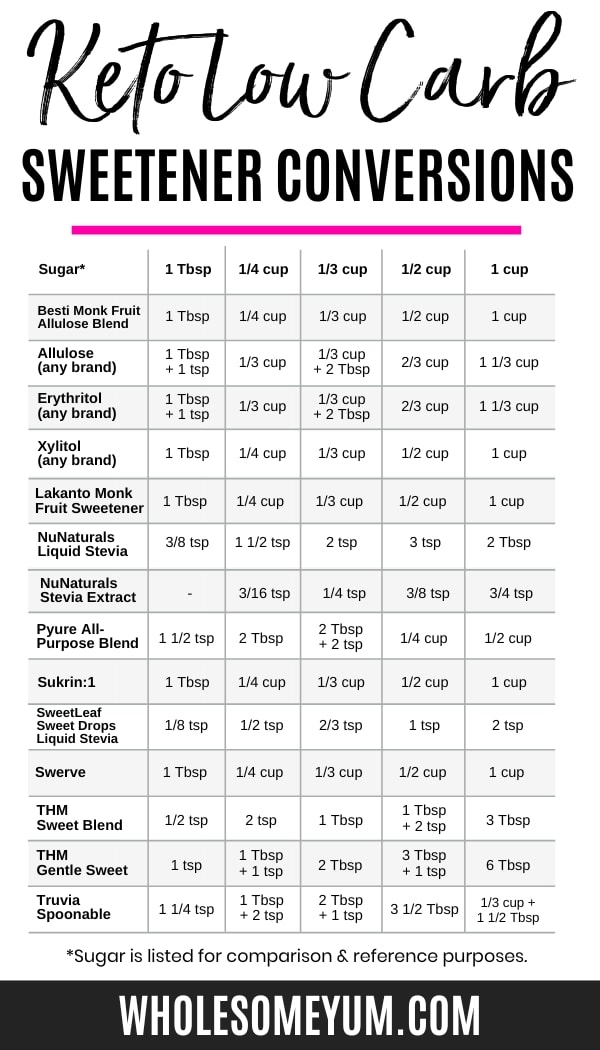
Keto Sweetener Conversion Chart
FREE PRINTABLE: SWEETENER CONVERSION CHART
Join 300,000+ others to get a FREE printable conversion chart for keto sweeteners!
GET IT NOW










359 Comments
Sandra
0Hello Maya: Where is the area that you have a form to fill in so that you can send the conversion chart to me? Hopefully, this has been updated for 2022. Should I keep an eye out for a link to his form? Thank You for all of your hard work, planning, and postings of so many useful recipe and hints. In going through the spices in the kitchen, I’ve discovered that there’s a few important ones that are either gone or very low; that’s why I thought that the conversion chart will help me to keep track of the sweeteners also.
Wholesome Yum D
0Hi Sandra, This post has recently been updated. Unfortunately, at this time, I do not have a PDF version of the conversion chart.
Michael
0I’m new to low carb and keto and there is so much to learn. I have to rethink my whole thought process of what is healthy and good for you but I’m hanging in there because of the health benefits.
Zenaida
0Can u combine stevia better stevia powder, monk fruit, and allulose to equal sugar?
Maya | Wholesome Yum
0Hi Zenaida, The closest equivalent to sugar is monk fruit allulose blend.
Vicki
0Thanks for teaching me about allulose and monk fruit and combinations I never knew existed. I appreciate the great recipes and information you share!
Sherry
0Do you have a conversion chart for lucuma powder? Thank you. Sherry
Wholesome Yum A
0Hi Sherry, this is not as common a sweetener so at this time I don’t have conversions for it.
Mitchell
0What sugar substitute would work best with an ice cream maker (Cuisinart) for ice cream, sorbets or yoghurt?
Wholesome Yum D
0Hi Mitchell, I prefer powdered Besti in most of my ice cream recipes, here is one of my most popular ice cream recipes.
Bev
0How can I print the sweetener conversion chart?
Wholesome Yum D
0Hi Bev, You can access this in printed form in the members area of the site.
Shiendy
0Want 2 start doing these recipes what cupcakes work out best? Can I substitute oil instead of butter? How much oil is a third cup of butter?
Wholesome Yum D
0Hi Shiendy, Here is a recipe for keto chocolate cupcakes. Depending on the recipe, that will determine if you can substitute oil for butter and how it’s measured.
Nancy
0I have been using the Truiva Complete. It measures cup for cup like sugar. I hope this will work in the Maya recipes. Thanks
Sharon A.
0I have taken xylitol and ground it into powder, thereby making powdered xylitol to substitute for regular, or any other powdered sugar. When doing so, what is the conversion? Can you add this to your conversion chart, please?
Betty
0I use powdered stevia. This conversion doesn’t have that.
Wholesome Yum D
0Hi Betty, Pure stevia is very sweet in small amounts, while baking versions of these sweeteners are cut with erythritol and closer to a 1:1 ratio with table sugar. Be sure to check the manufacturer’s website, most will give you a sweetness ratio and include a conversion chart. My suggestion to sweeten your pie is using Besti Monk Fruit Sweetener With Allulose. Besti natural sweetener replaces sugar 1-to-1, but has zero calories and zero net carbs. Use Besti in place of sugar for cooking, baking and topping!
Vicki
0Hi I am in Australia, I have Natvia sweetener.
It is a blend of Stevia and Erythritol, the ingredients are listed as: Natviarol(TM)Sweetener (Erythrirol, Organic Steviol Glycosides [0.56%]). Which of the products on your list does it best equate to?
Wholesome Yum D
0Hi Vicki, My products are a proprietary blend but I do not have a product that includes stevia.
Terri
0I have bags of allulose and monk fruit, but love your monkfruit with allulose. Can I mix mine together so I don’t waste? If so, what is the conversion of the two to taste like yours?
Maya | Wholesome Yum
0Hi Terri, Other brands of monk fruit are also typically blends, so there isn’t a straightforward conversion, but feel free to mix them together 50/50. The results will be different, though, because other monk fruit brands use erythritol as a filler, so you’ll actually be getting a combo of erythritol, allulose, and monk fruit.
Sandra
0Is this information on the different sweeteners & the charts available as a printed book?
Wholesome Yum D
0Hi Sandra, You can access this in printed form in the members area of the site.
Patricia Young
0My smoothie recipe calls for 6 tbsp powdered erythritol. I would like to substitute granulated monk fruit sweetener, which I have in my home. How much monk fruit should I use in this recipe? Thank you
Wholesome Yum D
0Hi Patricia, I recommend using my sweetener conversion chart to make sure you are using the correct amount.
Sue
0Is allulose the best sugar substitute to use for homemade ice cream?
Wholesome Yum D
0Hi Sue, I have several ice cream recipes that use natural sugar substitutes.
Arli
0Hi…I am doing keto, and have spent hours in the stores, looking at labels. I get the whole organic thing…but please explain why actual organic sugar should not be used, but replaced by something else, that basically has the same net carbs and is so basic? ( Primarily for baking)
Wholesome Yum D
0Hi Aril, Organic does not equal low carb. Organic sugar is still very high in net carbs. If you are looking for a low carb alternative Wholesome Yum Besti sweetener is 0 net carbs.
Chieko
0My favorite is your unique blend of Monk Fruit Allulose. I also use Swerve. In fact, I mix them in an old yellow Domino’s sugar tub (will transfer it to a glass container later). I found adding a few drops of stevia to the mix in teas and coffees kicks up the sweetness which my parents prefer. Would love to know if your sweetners also organic. Thanks for putting together the guide!! and love your products, website and recipes
Wholesome Yum D
0Hi Chieko, Besti is made with all natural ingredients.
Jan
0Any idea when the Brown Sugar sweetener will be available again?
Wholesome Yum D
0Hi Jan, Besti Brown is now in stock with limited quantities available.
Allison
0I have used Sweve Powdered Sugar alternative in a frosting recipe, but it leaves a weird aftertaste and numbing feeling in your mouth…. What’s your take on the best tasting all-around sugar replacement for frostings?
Wholesome Yum D
0Hi Allison, Wholesome Yum powdered Besti is the best replacement for sugar, it tastes, bakes, browns, and dissolves just like powdered sugar does with no after taste.
Jan
0What is the conversion of liquid allulose to Karo syrup for baking?
Wholesome Yum D
0Hi Jan, Sorry, I do not use Karo syrup while baking because it’s high in carbs.