
 Shop
Shop My
My Custom



Free Printable: Low Carb & Keto Food List
Get It NowBefore you start converting sweeteners, read my guide about sugar substitutes and keto sweeteners here — it’s crucial for understanding how they work and has a big section on baking. The most common question I get, though, is how to replace sweeteners in keto recipes. So, I created a sweetener conversion chart, as well as an easy calculator to do it for you. I’ll also talk about erythritol substitutes (the most common question), and the recipe differences when using erythritol vs stevia, monk fruit vs stevia, and allulose vs erythritol.
If you’re overwhelmed about which keto sweetener to try first, I highly recommend starting with Besti Monk Fruit Sweetener With Allulose! It tastes and bakes just like sugar, but unlike other brands of monk fruit, it also dissolves and browns like sugar as well. It’s great for a keto diet and you don’t have to sacrifice taste.
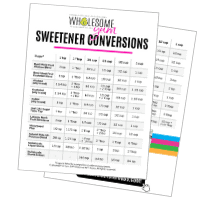
FREE PRINTABLE: SWEETENER CONVERSION CHART
Join 300,000+ others to get a FREE printable conversion chart for keto sweeteners!
GET IT NOWHow To Substitute Sweeteners In Recipes

If you need to replace a sugar-free sweetener, try to replace it with one that has a similar volume and sweetness level, and the same type (liquid, granulated, or powdered). This is the safest way to get a positive end result. Use the sweetener conversion chart or calculator below for the exact amount.
If you can’t, the way to do it will vary depending on the recipe. Here are some general tips:
- To replace a granulated sweetener with a concentrated one, replace that bulk with something else. If you are baking, this would be whatever flour the recipe uses. As long as that flour is not drying (like coconut flour), it should turn out okay. But, you will likely need a little more of the converted amount of concentrated sweetener, to account for the extra (not sweet) flour. If the flour is drying, like coconut flour, you’ll need more liquid as well to compensate.
- To replace a granulated sweetener with a liquid one, add more of the dry ingredients in the recipe to absorb the extra liquid.
- To replace a concentrated sweetener with a granulated one, add more of the wet ingredients in the recipe to balance out the extra bulk from the granulated sweetener.
- Check the section on baking with erythritol for more tips.
Are you seeing the pattern? There are no guarantees when replacing sweeteners of different types. These tips are a guideline, but not guaranteed to work. At least this should give you a general idea.
You want to try to maintain the same consistency of the batter or dough that you are working with, while keeping a similar level of sweetness. It’s not always easy!

Natural Keto Sweetener Conversion Chart
There are various sources out there for converting among sugar-free sweeteners. The problem is that I have yet to see a chart that lists many or most of them in one place, in a concise way. I put together a chart that you can use as your go-to place for sweetener conversion.
Want a printable version of the sugar-free sweetener conversion chart? Sign up below and I’ll send it to you!
FREE PRINTABLE: SWEETENER CONVERSION CHART
Join 300,000+ others to get a FREE printable conversion chart for keto sweeteners!
GET IT NOW| Sugar | 1 tsp | 1 Tbsp | 1/4 cup | 1/3 cup | 1/2 cup | 1 cup |
|---|---|---|---|---|---|---|
| Besti Monk Fruit Allulose Blend | 1 tsp | 1 Tbsp | 1/4 cup | 1/3 cup | 1/2 cup | 1 cup |
| Wholesome Yum Allulose | 1 1/4 tsp | 1 Tbsp + 1 tsp | 1/3 cup | 1/3 cup + 2 Tbsp | 2/3 cup | 1 1/3 cup |
| Erythritol (any brand) | 1 1/4 tsp | 1 Tbsp + 1 tsp | 1/3 cup | 1/3 cup + 2 Tbsp | 2/3 cup | 1 1/3 cup |
| Allulose (any brand) | 1 1/4 tsp | 1 Tbsp + 1 tsp | 1/3 cup | 1/3 cup + 2 Tbsp | 2/3 cup | 1 1/3 cup |
| Xylitol (any brand) | 1 tsp | 1 Tbsp | 1/4 cup | 1/3 cup | 1/2 cup | 1 cup |
| Just Like Sugar Table Top | 1 tsp | 1 Tbsp | 1/4 cup | 1/3 cup | 1/2 cup | 1 cup |
| Lakanto Monkfruit Sweetener | 1 tsp | 1 Tbsp | 1/4 cup | 1/3 cup | 1/2 cup | 1 cup |
| MonkSweet Plus | 1/2 tsp | 1 1/2 tsp | 2 Tbsp | 2 Tbsp + 2 tsp | 1/4 cup | 1/2 cup |
| NuNaturals NuStevia Stevia Extract | – | – | 3/16 tsp | 1/4 tsp | 3/8 tsp | 3/4 tsp |
| Natural Mate All-Purpose Blend | 3/8 tsp | 1 1/8 tsp | 1 Tbsp + 1 1/2 tsp | 2 Tbsp | 3 Tbsp | 6 Tbsp |
| NuNaturals NuStevia Liquid Stevia | 3/8 tsp | 3/8 tsp | 1 1/2 tsp | 2 tsp | 3 tsp | 2 Tbsp |
| Pure Monk | – | – | 1/6 tsp | 1/4 tsp | 1/3 tsp | 2/3 tsp |
| Pyure All-Purpose Blend | 1/2 tsp | 1 1/2 tsp | 2 Tbsp | 2 Tbsp + 2 tsp | 1/4 cup | 1/2 cup |
| Sukrin:1 | 1 tsp | 1 Tbsp | 1/4 cup | 1/3 cup | 1/2 cup | 1 cup |
| Swanson Purelo Lo Han Sweetener | – | 1/4 tsp | 3/4 tsp | 1 tsp | 1/12 tsp | 3 tsp |
| SweetLeaf Sweet Drops Liquid Stevia | – | 1/8 tsp | 1/2 tsp | 2/3 tsp | 1 tsp | 2 tsp |
| Swerve | 1 tsp | 1 Tbsp | 1/4 cup | 1/3 cup | 1/2 cup | 1 cup |
| THM Sweet Blend | – | 1/2 tsp | 2 tsp | 1 Tbsp | 1 Tbsp +2 tsp | 3 Tbsp |
| THM Gentle Sweet | 1/3 tsp | 1 tsp | 1 Tbsp + 1 tsp | 2 Tbsp | 3 Tbsp + 1 tsp | 6 Tbsp |
| Truvia Spoonable | 1/2 tsp | 1 1/4 tsp | 1 Tbsp + 2 tsp | 2 Tbsp + 1 tsp | 3 1/2 Tbsp | 1/3 + 1 1/2 Tbsp |
Keto Sweetener Conversion ChartPin It For Later!
What’s Not In The Sweetener Conversion Chart
The following sweeteners are not in the conversion chart, for these reasons:
- Artificial sweeteners – I do not advocate artificial sweeteners (including sucralose and aspartame), and suggest finding a better low carb natural sweetener option instead. You can read more about it in the Sugar Substitutes article.
- Natural sweeteners that use sugars as bulking agents – Examples of such bulking agents are dextrose and maltodextrin. These raise blood sugar and are often GMOs.
- Natural sugar sweeteners – Granulated natural sugar-based sweeteners (like coconut sugar) can be used 1:1 like sugar, so they require no conversion. Keep in mind they do still raise blood glucose levels. Most other natural sugar-based sweeteners are syrups (such as maple syrup, honey, agave, etc.), which are also excluded for the reasons below.
- Keto liquid sweeteners and syrups – These are excluded because they do not easily convert from granulated table sugar. The liquid aspect would require other modifications to be made to a recipe using table sugar. This can sometimes be true for converting among various granulated sweeteners as well, but not as often as when converting between granulated and liquid.
- Confectioners and brown sugar replacements – These are obviously specialized for certain uses, so there isn’t a point to convert regular sugar to them. They are not included in the sweetener conversion chart.
You can still read about these sweeteners and their sweetness level compared to sugar in my Sugar Substitutes post.
Sweetener Conversion Calculator
I also created a calculator that does the work for you, so you don’t have to figure it out from the sweetener conversion chart!
Just bookmark this page to have the keto sweeteners calculator handy anytime you need it…
Keto Low Carb Sweetener Conversion Calculator
FREE PRINTABLE: SWEETENER CONVERSION CHART
Join 300,000+ others to get a FREE printable conversion chart for keto sweeteners!
GET IT NOWComparing The Most Common Sweeteners
You can learn about what the most common keto-friendly sweeteners are and how they work in baking in my Sugar Substitutes post, which is why I recommend reading that first. But below are specific comparisons people ask about the most. All of them are keto friendly, but there are differences in their sweetness and baking properties.
Erythritol vs. Stevia
Erythritol and stevia are totally different, but there are some commonalities because of how stevia is typically sold:
- Erythritol is a sugar alcohol derived from corn via fermentation, whereas stevia extract comes from stevia leaves and has a very concentrated sweetness from the stevia plant.
- Erythritol is 70% as sweet as sugar. Stevia is 100 to 300 times as sweet as sugar. This makes plain erythritol easier to use than plain stevia.
- Stevia can have a bitter aftertaste, especially in its pure form. Erythritol has very little to no aftertaste, but may show a mild cooling effect, similar to mint.
- Both erythritol and stevia have 0 glycemic index, 0 calories, and 0 grams net carbs.
- Many brands of stevia are actually blended with erythritol to make a 1:1 sugar substitute. These will have similar properties to plain erythritol, but sweeter. However, some brands of stevia are pure extract (very concentrated) and some 1:1 brands are blended with maltodextrin or dextrose instead (these are other names for sugar — not good).
Monk Fruit vs. Stevia
Monk fruit and stevia have more in common than erythritol and stevia do:
- Like stevia extract, monk fruit extract comes from a plant and is very concentrated — about 150 to 400 times sweeter than sugar. This means you need only a very small amount of them to make a recipe sweet, but they can be difficult to use for this reason.
- Also like stevia powder, monk fruit based products tend to be mixed with other sweeteners or bulking agents. This is in part because pure monk fruit extract is hard to come by and expensive, but also because blending makes monk fruit easier to use.
- Both monk fruit and stevia extracts come in powder or liquid form when you buy them concentrated. They can be part of granulated sweetener blends, though.
- Both monk fruit and stevia have 0 glycemic index, 0 calories, and 0 grams net carbs.
- In contrast to stevia, monk fruit extract has less bitter aftertaste. This makes it a good choice for people sensitive to the aftertaste of stevia.
Allulose vs. Monk Fruit vs. Erythritol
Allulose, erythritol, and monk fruit are all pretty different from one another, but monk fruit is often blended with erythritol or (less commonly but far superior) with allulose.
- Because monk fruit extract is hundreds of times sweeter than sugar and difficult to use on its own, most brands of monk fruit are blended with erythritol and will have erythritol-like properties. However, Besti Monk Fruit Allulose Blend is blended with allulose instead, so will have (much more desirable) allulose-like properties.
- Allulose and erythritol have the same sweetness (70% as sweet as sugar), and both have a pleasant taste, with no bitterness. They are equivalent on the sweetener conversion chart.
- Erythritol has a slight cooling sensation, whereas allulose does not.
- Even though allulose and erythritol have similar sweetness, they are structurally very different. Allulose is a rare sugar (in the same family as glucose, lactose, etc.) so it actually tastes and acts like sugar, but because we can’t metabolize it, it still has 0 grams net carbs. Erythritol is a polyol (sugar alcohol), so it behaves less like sugar.
- Erythritol, like other sugar alcohols, is more likely to cause stomach upset than allulose. Monk fruit on its own does not cause this either, but brands of monk fruit that contain erythritol (as most have) can.
- Allulose is excellent at locking in moisture, which means it creates moist, soft baked goods. Erythritol tends to be more drying. Pure monk fruit extract is neutral.
- Allulose browns, caramelizes, and dissolves like sugar. Erythritol does none of these things. Adding monk fruit to either of them does not change how they behave.
- Erythritol (and erythritol blends of monk fruit) can crystallize, leading to a gritty texture. Allulose and pure monk fruit extract do not.
- Monk fruit, erythritol, and monk fruit all have 0 calories, 0 grams net carbs, and 0 glycemic index.
Erythritol vs. Xylitol
Erythritol and xylitol are both sugar alcohols, so they are in the same structural family. They are similar but have some key differences:
- Erythritol is 70% as sweet as sugar, whereas xylitol measures 1:1 with sugar.
- Erythritol has 0 glycemic index, but xylitol has a slightly elevated glycemic index of 7. This is still very good compared to table sugar, which has a glycemic index of 65, but is less ideal for keto or diabetics.
- Xylitol does not have the cooling aftertaste that erythritol has, and in general tastes more similar to sugar than erythritol does.
- Erythritol is less likely to cause gastrointestinal distress than xylitol (or other sugar alcohols), because most of it gets absorbed in the small intestine (but is poorly metabolized [*]) and is later excreted unchanged into the urine. All other sugar alcohols, including xylitol, reach the large intestine instead, where they may lead to stomach pain, bloating, or diarrhea. But, erythritol can still cause stomach issues for some people.
- Xylitol is lethal to dogs [*], so people with dogs may prefer not to have it in the house.
- Erythritol has 0 grams net carbs. Because xylitol is partially absorbed, about 1/4 of the total carbs should be counted as net carbs (1 gram per teaspoon serving).
Natural vs. Artificial Sweeteners
You can read more about artificial sweeteners and why I don’t recommend them in my Sugar Substitutes post.
Erythritol Substitute Options
If you want an erythritol substitute, consider the following options:
- Sweetener blends – These are usually designed to measure 1:1 with sugar, which is very convenient. Most brands of monk fruit and stevia are actually erythritol blends, so they will behave the same way, but they are sweeter. If you are replacing erythritol in a recipe with a 1:1 blend, use 3/4 cup of the blend for every 1 cup of erythritol. (Or use 1 1/3 cups erythritol to replace each cup of the blend if converting in the other direction.) The sweetener conversion chart and calculator above make this easy to do. Monk fruit allulose blend will have the same conversion, but will yield better, more allulose-like results (see the Allulose vs. Monk Fruit vs. Erythritol section above).
- Allulose – The best erythritol substitute in my opinion! In fact, most of the time the results are even better, since allulose dissolves and browns better.
- Xylitol – This won’t solve the issue if you can’t tolerate sugar alcohols, but works if you just ran out of erythritol.
- Pure Monk Fruit Or Stevia – These are very concentrated without being part of a blend, so only recommended for recipes where the bulk aspect of sweetener isn’t needed, such as drinks. Avoid substituting them for erythritol in keto baking.
Pinterest-Friendly Sweetener Conversion Chart
The above natural low carb sweeteners chart can be helpful, and I hope you’ll bookmark this page to refer back to it. Another convenient way to save the conversions is to use this Pinterest-friendly image:
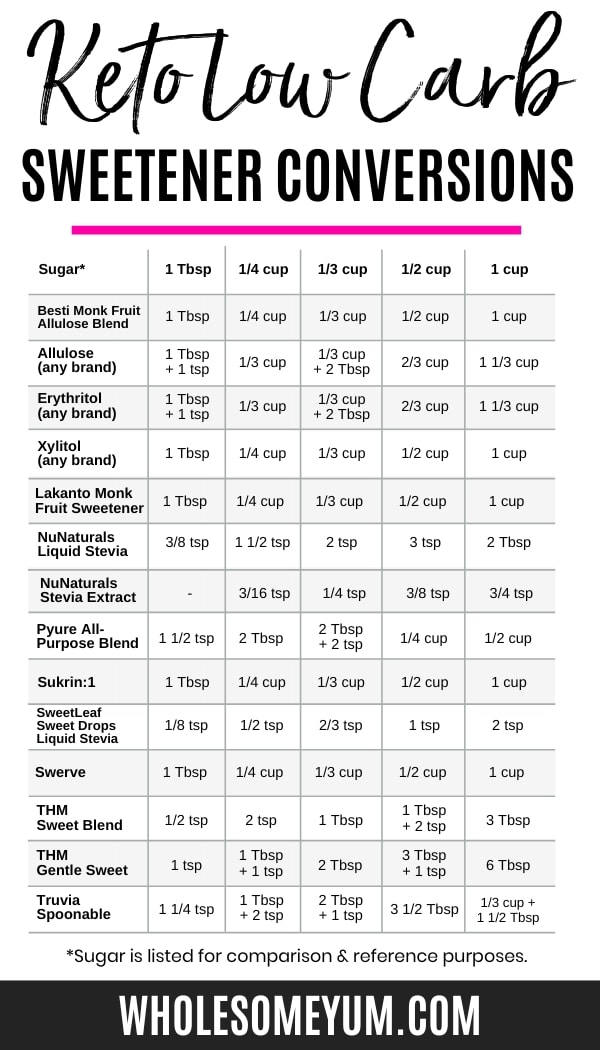
Keto Sweetener Conversion Chart
FREE PRINTABLE: SWEETENER CONVERSION CHART
Join 300,000+ others to get a FREE printable conversion chart for keto sweeteners!
GET IT NOW










359 Comments
Nichole Anastas
0Hi
I am having trouble finding Stevia Sweet baking in any conversions. Did i purchase the wrong one. I saw baking and thought it would be the correct one to cook with
Wholesome Yum M
0Hi Nichole, Baking stevia is generally 1:1 with table sugar, but to be safe, check with the manufacturer’s website before using it to bake with. If you are interested in finding a great all-around keto-friendly sweetener, I recommend trying Besti Sweeteners.
Donna Roberts
0I may have missed it but is splenda on the chart
Wholesome Yum M
0Hi Donna, Splenda Naturals is on the chart, as it’s made from whole food ingredients. The other versions of Splenda are artificial sweeteners, which I don’t recommend.
Jonathan
0Is the nutrition listed per 1 tender or 2?
Wholesome Yum M
0Hi Jonathan, Which recipe are you referring to?
Sally Broadt
0I love your stuff
Cheryl
0Hello sometimes with baking have stomach issues. Typically use monfruit, coconut flour, almond flour. Is one of this ingredients culprit. Can you make suggestions
Thank you
Wholesome Yum M
0Hi Cheryl, Typically coconut and almond don’t cause GI issues, so that means it’s probably the sweetener. What kind of monk fruit are you using? Is it a blend with erythritol? Sometimes the sugar alcohols from the erythritol can cause stomach upset. My preferred sweetener is Besti Monk Fruit Allulose Blend. It doesn’t contain any sugar alcohols, so its more tummy friendly.
Keilla Jones
0Hello! I have a question on which sweetener would you suggest for hot tea? I drink hot tea in the morning and like to put a little sweetener in it. Looking for an over all sweetener that will be good for multiple uses
Wholesome Yum M
0Hi Keilla, I love to use Besti Monk Fruit Allulose Blend for beverages. It dissolves nicely in hot or cold liquids, so it’s great to keep in a sugar bowl on the table.
Jaclyn
0Can you please turn this conversion calculator into an app?? I use it all the time! It’s amazing! Thank you!!
Maya | Wholesome Yum
0Hi Jaclyn, I’m so glad it’s helpful! This calculator will be added to the Easy Keto App by Wholesome Yum soon. You can try out the keto app here.
Jaclyn
0That’s great news! Thank you!
Richard J. Kohout
0I didn’t get to read all the comments, but from the Sweetener Guide which seems excellent you missed a new sugar-free sweetener which should be excellent for a Keto/Low-Carb Diet. Bocha Sweet is Kabocha Extract which is 100% pentose. It converts 1:1 to sugar, bakes and tastes like sugar and I detect no aftertaste or cooling effect. What do you think of Bocha Sweet as a sugar substitute?
Wholesome Yum M
0Hi Richard, I’m sorry, I don’t have any experience with this sweetener. I have created my own brand of sweeteners called Besti that I use in my kitchen. My favorites lately are the Besti Brown Monk Fruit Sweetener with Allulose and the Besti Monk Fruit Sweetener with Allulose.
Christina
0with all these American measurements being wildly different to that of our European ones it seems, can you please clarify what constitutes a tablespoon, a cup, a teaspoon, but especially a cup?!
Thanks
Wholesome Yum M
0Hi Christina, All of my recipes have a button on the recipe card where you can switch between US cups and metric measurements! I hope this helps.
Tatum Graham
0Hi,
I am wanting to make Keto cinnamon rolls. The original recipe calls for 1/4 cup erythritol for the batter and 3 tbsp erythritol for the filling. I only have Lakanto 1:1 classic white Monk Fruit. Is 1:1 Monk fruit a good replacement for this? If so, what would the conversion be?
Thank you!
Wholesome Yum M
0Hi Tatum, Lakanto is in the conversion calculator. 1/4 cup erythritol would convert to 2 Tablespoons + 2 teaspoons. 3 Tablespoons would convert to 2 Tablespoons.
Tatum Graham
0Thank you!!
Johanne Peale
0I have Pure Monk fruit from Julian Bakery. Can I use it in baking? I am looking for a Ginger Snap Recipe. According to the conversion chart I would use 2 tsp. for 1 cup of sugar. Would I need to add more flour almond or coconut?
Maya | Wholesome Yum
0Hi Johanne, I don’t usually recommend replacing sugar with such a concentrated sweetener in baking, because it would throw off the consistency of your batter or dough. Simply adding more flour rarely produces desired results, so the whole recipe would need to be reworked. This is one of the main reasons I recommend sweeteners that are 1:1 sugar replacements, such as monk fruit allulose blend, as they are much easier to work with and this one behaves how sugar would in recipes. For ginger snaps, I actually prefer a brown sweetener – here is my keto ginger snap recipe.
Maria Hamalis
0hi there, My name is Maria and I have a question. I have Linodiet baking which is a combination of erythritol, steviol GLycosides. I am about to make your keto red velvet cake and I need to put in 1 and a half cups of erythritol. What is the conversion pls? Thanking you in advance.
Wholesome Yum M
0Hi Maria, I am sorry, I’m not familiar with that brand. You will need to check the manufacturer’s website to figure out if your sweetener is 1:1 with sugar.
Crystal
0Ummm…your calculator says I need over 13 cups of erythritol to replace 2 tablespoons of monk fruit?
Maya | Wholesome Yum
0Hi Crystal, That sounds right for pure monk fruit – it’s a couple hundred times as sweet as sugar, and erythritol is even less sweet. However, I wouldn’t recommend making that swap in a recipe because the volume is too different. If you’re thinking of just a brand of monk fruit that you use similarly to sugar, you should put in that brand in the calculator, as these are not actually pure monk fruit – they are over 90% other filler.
Beverly
0If I want to make your cookies like the chewy peanut butter cookies I enjoyed as a child, I was thinking Allulose might make a more chewy cookie, but I don’t want a cookie that is cakey.
Should I use a combination of Allulose with Erythritol? on what ratio?
Thanks for your advice.
Wholesome Yum M
0Hi Beverly, Yes, allulose will give you chewy cookies. You will likely need to increase the amount of allulose used if the original recipe you are using calls for sugar or a sweetener blend. Please use the sweetener calculator above to determine how much allulose you will need.
Marnie
0Thank you info very helpful. appreciated
Marinda
0Hi, I found these tips very informative.
Chelsie
0Hi! I will go back and look over the chart, but when you listed allulose + monk fruit blend.m, is that crystallized or powdered form? And how would that differ from the other?
Also, just a side note, all the adds make it very difficult to read from a cell phone since they pop up on the bottle and top…maybe it will be easier to read from a laptop, but something to consider for your viewers 🙂 Thanks!
Wholesome Yum M
0Hi Chelsie, The recipe will specify whether you need a powdered or granulated sweetener. The difference is in the texture, so if you are planning to make ice cream, pudding, or frostings, then you will definitely want to use a powdered form for the smoothest consistency. If you are interested in going ad-free, check out Wholesome Yum Plus here.
Mae
0How about converting granulated erythritol to a powdered one? Thanks
Maya | Wholesome Yum
0I don’t recommend making this swap, because they will change the texture in recipes. If you have a question about a specific recipe, please leave a comment on that recipe and I can suggest whether the swap would work there or not.
Chelsie
0Thank you so much! I was wondering if you had a membership like that 🙂
Cherlyn
0Can I use truvia spoonable in place of monk fruit/allulose in your almond pound cake?
Wholesome Yum M
0Hi Cherlyn, Yes, that brand is listed in the calculator. You will need 3 Tablespoons + 1 teaspoon.
Cherlyn Kelly
0Love your site. Are you saying it’s not good to bake with Stevia? I use truvia powder and packets. Can I substitute that in the baking recipes for the monk fruit allulose blend?
Wholesome Yum M
0Hi Cherlyn, Stevia is perfectly acceptable to bake with, but it’s recommended to use a ‘baking blend’ when using stevia. Using a blend will help to negate the bitter aftertaste stevia sometimes has. That said, you will get different results if you use a stevia baking blend in place of the Besti Monk Fruit Allulose Blend. Erythritol (which is the common bulking agent used in a stevia baking blend) will create a more crisp final product. Allulose will produce a softer, more tender product. Both are great, but it really depends on what recipe you are using it for as a substitution.
Ed Stoneberger
0Your calculator needs some work, you’re showing a 1:1 ratio of Ethrythritol with sugar as well as allulose.
But the conversion chart is spot on:)
I am just starting to research sugar alternatives and from what I can tell Erythritol seems to the best base sweetener.
That’s fine for sweetening liquids but what would be the best product to use for baking? I’m looking for texture equivalents to sugar.
thank you in advance!
Wholesome Yum M
0Hi Ed, The calculator seems to be working correctly. There are several types of erythritol in the list, so be sure you are selecting erythritol or allulose and not erythritol blend or allulose blend which are 1:1 with sugar. Personally, I think allulose is great as a table sweetener to use in beverages (thanks to its unique ability to dissolve in liquids). For baking, I like to use both erythritol and allulose as each sweetener produces different results in baked goods. Allulose gives tender, soft textures to cookies and cakes. It’s also an excellent choice for ice creams to help create a soft, scoopable consistency. Erythritol provides a crisp texture to baked goods. It also can be used as a coating for things like snickerdoodles or churro chaffles. I hope this helps!
Faiz
0I use Truvia which I understand is not that great. Which sweeteners do you recommend as low carb and which does not increase the sugar level, cannot find the chart. Please help. Thanks.
Wholesome Yum M
0Hi Faiz, You are in the right place! This article breaks down the best keto-friendly sweeteners. The chart that breaks down the sweetness level of each of these sweeteners is located right above the sweetener calculator. Feel free to ask any questions you may have here! My absolutely top recommended keto sweetener is Besti Monk Fruit Allulose Blend.
Bee
0It is probably also worth mentioning that chicory is an emmenagogue — meaning it can cause heavy periods and an elevated risk of miscarriage. (Ernst, 2002) Have personally experienced the former, but fortunately the effect seems to be reversible!
Wholesome Yum M
0Hi Bee, Thank you for the additional information!
Lisa
0This might seem like a silly question, so I apologize in advance! I’m pretty new to keto (6wks) but I’m ready to start changing up my menu. My question is when figuring my macros, do I need to add any calories or carbs, (I have been counting total carbs, good or bad?) When I use say a cup of Monk Fruit Erythritol Blends? Do I ignore all of it? The app I use (Carb Manager) puts a really high number on this sweetener, so I’m confused.
Thank you in advance! I love all the info you’ve provided and will be back again and again!.
Wholesome Yum M
0Hi Lisa, Welcome to keto! Counting total carbs is fine. If you are interested, you can read more about how to calculate net carbs here. Counting calories isn’t strictly necessary on this diet, as it typically naturally reduces them, but some people do find they have to count. It just depends on if you are doing lazy keto with only carb counting, or strict keto where all macros and calories are counted. You can find more about the differences in the keto cheat sheet system. Keto sweeteners are generally not counted unless they include actual sugars in them, but if you are tracking total carbs with an app, it may not know to subtract them. I hope this helps!
Dan Vina
0I guess you do not get a commission from Splenda, so you don’t include it in your chart!
Wholesome Yum M
0Hi Dan, Splenda Naturals is in the sweetener calculator.
Karen Schaefer
0Looking for a conversion from powder sweetner to Dolcedi Liquid sweetner Made with apple juice, low GI, great in liquids. How I would am looking for the best way to use it in place of the powder sweetner.
Thanks
Wholesome Yum M
0Hi Karen, I am not familiar with this sweetener, however, I don’t recommend using liquid sweeteners in the recipes. Usually, a liquid sweetener will change the ratios of the recipe (especially in baking) and it won’t turn out correctly. I hope this helps!
Bridget
0I have powdered Splenda Naturals Stevia and I’m not sure where this falls in your conversion chart. How much would I use for this cheesecake? Thank you! I would really like to try this recipe!
Wholesome Yum M
0Hi Bridget, Which cheesecake recipe are you wanting to try?
Bridget
0I have powdered Splenda Naturals Stevia and I’m not sure where this falls in your conversion chart. How much would I use for this cheesecake? Thank you! I would really like to try this recipe!
I’d like to try The Best Keto Cheesecake recipe.
Wholesome Yum M
0Hi Bridget, If your brand of sweetener is ‘cup for cup’ the same sweetness as sugar, then you will need to use slightly less than what the recipe calls for. Use 3/4 cup + 2 Tablespoons of sweetener. I hope this helps.
Dory
0My whole family loves this recipe. Tastes great. I did have a question about the sweetner. I used swerve confectioners in the filling. The recipe says to use powdered eyrthritol, or powdered monkfruit with eyrthritol. Using the calculator it said using swerve confectioners I should use 3/4 cup+3 tbsp to equal 11/4 cups of powdered eyrthritol. But then it said to use 1:1 ratio using powdered monkfruit with eyrthritol compared to swerve confectioners. It didn’t mention in the filling recipe the need to make any conversion for using powdered monkfruit with eyrthritol instead of powdered eyrthritol. Is that because the need to use conversion is implied or is it that I should be using 1 1/4 cup of swerve also. Thanks for the amazing recipes
and I’m using the calculator incorrectly.
Wholesome Yum M
0Hi Dory, Which recipe are you referring to?
Dory
0*I mean is it implied the need to use conversion OR am I using the calculator incorrectly
Nancy Nichols
0I’ve found a recipe on line that calls for liquid monk sweetner. I have a sugar form of monk, I was wondering how to make it into a liquid form that would equal its liquid mate. I would like to make coconut crack bars as a treat as I’m on a keto diet. Any help would be grateful thank you
Wholesome Yum M
0Hi Nancy, Unfortunately, monk fruit erythritol sweetener probably won’t get you the same concentrated level of sweetness needed for the recipe. Concentrated monk fruit liquid sweetener is hundreds of times sweeter than sugar.
Sharon Hunter
0Hi Maya.. I made your blueberry muffins. Yum! The only thing I am confused with is the sugar part. I used Pyure organic All Purpose Stevia blend. I used a half of cup like in your recipe. I was totally shocked and super disappointed to find out there were 58 net carbs in one muffin. WHAT DID I DO WRONG?
Thank you Sharon
Wholesome Yum M
0Hi Sharon, I’m not sure how you got to that number, but it doesn’t sound right. Feel free to enter the recipe into an online recipe calculator and exchange the erythritol for your sweetener choice. It should give you a more accurate result. The nutrition info for the recipe is also directly on the recipe card above, using the USDA Food Database as the source of nutrition info for each ingredient.
mags
0This is by far the most complete site of information about sweeteners as I’m just starting a keto diet and am finding so many different people use a variety of sweeteners. This really helped me. I appreciate your thoroughness.
Sharon
0I live in Ontario, Canada and do not have access to some of these sweeteners like Wholesome Yum Allulose, or Besti Monk Fruit. Even Lakanto is hard to find and some Lakanto products are not available either like the Lakanto maple flavored syrup. I was trying to make your simple syrup recipe and it did not work out so well. If any of your readers are from Canada I would like to hear what sweeteners they use. Some of my family have issues with Xylitol and Stevia is definitely a No No. Thanks for your response and a Big Thank you for your many delicious recipes.
Wholesome Yum M
0Hi Sharon, Besti will be in Canada very soon! Please sign up here to be notified when it’s ready.
Miranda
0Hi Maya. Thank you so much for all your information on all the different sweeteners. I’m new to this sort of dieting; I often find myself on your website and actually just bought your book. I’ve shared this information with many of my friends.
The real question I have is what is your favorite sweetener? All of this is helpful but overwhelming to someone who is just starting out, and I’d love to know what your “go to” is. I got started with all this with the 131 Method, but she uses Swerve – which is so disgusting to me. Your cookbook has a lot of recipes for erythritol. Do you prefer erythritol to all else, or would you say that allulose is a better option (I know it’s fairly new). NOT referring to powdered vs. granular but to the different sources, when would you use one sweetener over the other?
I’m looking forward to hearing back from you!
Wholesome Yum M
0Hi Miranda, Lately I am loving my Besti Monk Fruit Allulose Blend. It dissolves, so it’s great for beverages as well as keto baking.
Sharon
0Thanks for the great sweetener information. I use many of your recipes and they are delicious. I live in Canada and cannot buy Besti sweeteners with erythritol or with allulose. I was able to buy Lakanto sweetners but recently they also are very hard to find. While searching amazon.ca I came across Sonourished 100% erythritol sweetener (Granular & powdered) Just wondering if you or any of your readers have used this brand and is so what your thoughts are on it. Thanks again for all your great work of creating recipes.
Wholesome Yum M
0Hi Sharon, Besti sweeteners are now available in Canada! Find them at WholesomeYumFoods.com!
Sue Rosoff
0Howdy!
I am looking for what to use to sweeten cool drinks with summer here – I sometimes use monk fruit / erythritol and try and dissolve it in a little hot water before adding it to soda water with lemon juice or cola extract – but I was wondering if in all this work you’ve done you came up with something that dissolves more easily in liquid? I use monk fruit / erythritol for my hot tea and the taste is fine. I tried Swoon? but it had a stevia-like after taste for me.. I was so bummed!! Anyway – since you’ve done so much on these sweeteners it occurred to me that you might have found something that worked better than the monk fruit / erythritol combo – like a spoon or two with a little boiling water that I stir but when I pour it into a glass, there’s always undissolved left.. I haven’t tried making a simple syrup… have you tried that?
Thanks!
Sue Rosoff
Maya | Wholesome Yum
0Hi Sue, I just posted a keto simple syrup recipe here! There’s a specific sweetener I recommend using that dissolves best – Monk Fruit Allulose Blend.
Eleanor Gibson
0Here in Netanya I can only buy liquid Stevia. Many recipes call for other sweeteners often erythritol. I do need a conversion chart for the sweeteners in so many dishes.
Help
Melissa
0Hi Eleanor, Depending on which recipe you are making, liquid stevia may not work. Some recipes need the bulk from the granular or powdered sweeteners to work. I would proceed with caution using liquid stevia for baking recipes especially.
anita
0I have tried all your sweeters and others on the market and I love your sweeteners. I am wondering will you be offering organic sweeteners in the future. For now, that is the only reason I do buy other brands even though I love yours.
Anita
Wholesome Yum M
0Hi Anita, Thank you so much for asking! I’ll look into this. Currently, Besti is non-GMO and made with natural ingredients, but not certified organic. I hope this helps!
Natasha
0May I please have an approximate conversion from 6 drops of liquid Stevia to Swerve Confectioners? (That’s the only sweetener that I have). Thank you!
Wholesome Yum M
0Hi Natasha, It varies by brand of stevia, but in general, I don’t recommend substituting a liquid sweetener for a granulated one in recipes. If you want to swap, I recommend asking on that specific recipe’s page so that I can advice as to whether a liquid sweetener will work. Often times, the change in consistency is an issue.
Gilly
0Thanks for this comprehensive list! I like xylitol especially for baking and making ice cream, then monk fruit sweetener (which is mostly erythritol)
Pat
0My recipe calls for 1/4 cup of erythritol which I don’t have. Can I substitute with Pyure liquid stevia and if so how much would equal 1/4 cup?
Wholesome Yum M
0Hi Pat, It honestly depends on what recipe you are making. If it is for baking, I would not use a liquid sweetener to replace a granulated sweetener, it changes the ratios of the recipe and doesn’t usually work out well.
Rose
0I’m going to replace 3/4 cup of sugar in a cake with erythritol. I want to use powdered erythritol to prevent crystallization. I only have the granulated erythritol, so I’m going to blend it to make my own powdered erythritol. I used your conversion of 3/4 cup of regular sugar to erythritol, which is 3/4 cup + 3 tbsp + 2 tsp erythritol. The conversion of 3/4 cup of regular sugar to powdered erythritol is 1 2/3 cups + 1 tbsp. Which amount do I use in the cake? Do I blend enough granulated erythritol to measure up to the converted powdered amount? Or do I just measure the powdered erythritol to 3/4 cup + 3 tbsp + 2 tsp? Thanks!
Wholesome Yum M
0Hi Rose, It is best to powder your erythritol first and then measure for your cake.
Michele
0Hello! I appreciate the conversion and calculation charts but what bulking agent and how much should I use when using Stevia (liquid and packets) to baking goods. I am unable to use any sweetener made with a sugar alcohol due to “embarrassing” and uncomfortable side effects.
Maya | Wholesome Yum
0Hi Michele, It really depends on the recipe, there isn’t a one-size-fits-all solution. Usually, I don’t recommend substituting a liquid sweetener or super concentrated sweetener in a recipe that uses a sweetener with more bulk. Have you tried allulose or monk fruit sweetener with allulose? Both of these have no sugar alcohols, no aftertaste, and are much easier to use in recipes than super concentrated stevia.
Lorelei
0Question….if I’m substituting allulose for a recipe that calls for powdered erythritol, will allulose work ok, even if it isn’t powdered?
Wholesome Yum M
0Hi Lorelei, It depends on the use. If you are baking the recipe, then it should work out fine. If you are making a frosting, then you may still experience grittiness from the granular sweetener. I hope this helps!
Barbara Gilbert
0I like what I see so far. I have read some interesting things about keto and low carb dieting I was not aware of. I’m looking forward to all the information in the program. I may even get the cookbooks!
Wholesome Yum M
0Hi Barbara, That’s fantastic! I hope you enjoy the information.
karen Maw
0Hi
I really want to try your keto and products however I live in the UK and I’m not able to get the sweeteners etc and it feels like a mind field to do it without some guidance. I have you on facebook so love the recipes you do. Any idea when you might be importing to the UK or on Amazon UK.
Wholesome Yum M
0Hi Karen, I am working hard to expand shipping capabilities outside of the U.S. Please sign up here to be notified when it’s available in your area. Thank you so much for your patience and support!
Bernice Bakstis
0How to mix my 100% monk fruit into Erythritol? I need amounts to a 1lb. Bag ?
Wholesome Yum M
0Hi Bernice, I am not sure. The amount will vary on how sweet your Monk Fruit is. It can be anywhere from 100-400x the sweetness of sugar.
Halli
0I love your information here about sweeteners! I have read somewhere that Allulose can be derived from corn. I have developed an intolerance to corn. Even the tiniest of pills with cornstarch binders will give me symptoms. What do you know about the presence of corn in Allulose? Thank you for your help!
Wholesome Yum M
0Hi Halli, Non-GMO corn is part of the fermentation process that produces allulose. There technically isn’t any corn in the final product, as it’s used for fermentation only. I can tell you that we’ve batch tested our allulose for corn allergens and it comes out at 0 ppm (parts per million), meaning no traces of corn were found. However, I can’t guarantee how your body would react to it. My suggestion would be to test the waters with a small amount of allulose and take note of how it makes you feel. I suspect that if you can tolerate erythritol without issue, then allulose should be fine as well.
Bernice Humphrey
0Will the sweetener conversion chart work for powdered alternatives?
Wholesome Yum M
0Hi Bernice, Yes there are several powdered sweeteners in the database!
Shruti Mishra
0Hey! Your blog is so helpful, appreciate the time taken to explain all this in such great detail!
My question was on baking with Xylitol.
I tried baking with erythritol – and exactly what you said – it crystallizes later – and had a slightly bitter aftertaste.
Any idea if this sort of crystallization happens with xylitol as well? Or is it better for baking?
Wholesome Yum M
0Hi Shruti, Xylitol behaves similarly to erythritol. It has a very ‘minty cooling’ sensation and can crystalize. Between the two, I would say erythritol is the more neutral of the two sweeteners.
Shruti Mishra
0Thank you so much for your prompt and detailed response ❤️
I better stick to erythritol then
Also read about Maltitol today – was added as a sweetner in a product I was looking at. How does that behave? Any experience with Maltitol?
Wholesome Yum M
0Hi Shruti, I do not recommend using maltitol. It although technically sugar-free, it affects glucose levels and is known for causing GI upset.
NITA
0Hi, What is the ratio of granulated sugar substitute to erythritol, please? I am looking for an easy sugar-free biscuit base to make for a cheesecake.
Wholesome Yum M
0Hi Nita, Erythritol is 70% as sweet as sugar, so if you are wanting to use a different sweetener from erythritol, you may need to cut back on the amount. It will just depend on how sweet the other sweetener is.
Elizabeth Haner
0I am looking forward to your guidance in my new eating plan. Your site is very inviting. Wish me luck!!
Stephanie
0Thanks for this great post! I thought I found a great sweetener blend with HighKey monk fruit stevia erythritol blend, but then I realized it has a very bitter after taste when baked (although not when raw unusually). I’m thinking of buying your allulose monk fruit blend…does that have any bitter aftertaste when baked? I think my husband and I are super tasters : / ha!
Wholesome Yum M
0Hi Stephanie, Allulose does not have a bitter aftertaste. Many people who are sensitive to erythritol, love using allulose! You can find pure Allulose here and Monk Fruit Allulose here.