
 Shop
Shop My
My Custom




FREE 5-Ingredient Recipe EBook
GET IT NOWWhy You Might Need A Cornstarch Substitute

Cornstarch is one of those ingredients I used to always have in the pantry and take for granted. Over time, though, I’ve needed to find a cornstarch substitute more times than I can count.
For me, the need for a cornstarch alternative evolved mainly because I started to prefer cleaner ingredients. Plus, I was low carb for many years, which meant cornstarch was off the table. But I also often get questions about it because readers just ran out — and that’s just as good a reason to need a substitute for cornstarch.
Whatever your reason, I’ve tried just about every alternative out there, so I put together this guide to help you find the right one for your needs.
I’ve also split the list into uses (everything from baking to frying to thickening and more!) and by general alternatives versus healthier ones. That way, you can choose depending on your main reason for needing one in the first place. Let’s do this!

What Is Cornstarch And What Does It Do?
Cornstarch is a super fine, white powder made from the starchy part of corn kernels. It doesn’t have much flavor on its own (kind of like flour), but it’s amazing for thickening things like soups, stews, and sauces; making fried foods crispy, and changing the texture of baked goods. Even though it acts a lot like flour, cornstarch is naturally gluten-free.
The main reasons I’m not a fan of cornstarch are its high glycemic index and the fact that over 90% in the U.S. is GMO. Even if these aren’t your reasons, you’re here for a cornstarch substitute for one reason or another, so I’ve got options!

Cornstarch Substitutes For Baking
Cornstarch makes baked goods soft, tender, and just a little crumbly. It’s often used in cake flour to create that light, fluffy texture. If you’re out, here are a few swaps that still work well for baking.
General Alternatives For Baking:
- All-Purpose Flour – This one’s easy to grab if you’re out of cornstarch. Use twice as much flour as you would cornstarch, but keep in mind the texture won’t be quite as tender.
- Rice Flour – Great for cookies or shortbread where that crumbly texture actually works in your favor. I swap in two tablespoons for every one tablespoon of cornstarch.
- Potato Starch – I’ve had the best luck with this cornstarch alternative in cakes. You can use it one-to-one, just like cornstarch.
Healthy & Low Carb Alternatives For Baking:
- Glucomannan Powder – This one’s packed with fiber and works well in chewy cookies or low carb breads. I usually start with 1/4 teaspoon for every 2 teaspoons of cornstarch.
- Almond Flour – I don’t use this for thickening, but it works when a recipe needs a little bulk. I do a 1:1 swap with cornstarch in baked goods.
- Psyllium Husk Powder – It turns into a thick gel when mixed with water and adds a chewy bite to breads. I use about 1/2 tablespoon for every tablespoon of cornstarch.
- Xanthan Gum – Great for creating chewy textures and providing structure, especially in gluten-free baking. A little goes a long way, and it can turn gummy if you use too much, so I start with just 1/4 teaspoon to replace each tablespoon of cornstarch.
- Flaxseed Meal – This works well in bread and other baked recipes. I use 1/2 tablespoon of ground flaxseeds to replace 1 tablespoon of cornstarch.

Substitutes For Frying
If you love a light, crispy coating on fried foods, cornstarch is a rockstar at this. It helps absorb moisture and keeps gluten from developing. These are the cornstarch alternatives I’ve tested to keep the crunch without it!
General Alternatives For Frying:
- Potato Starch – This starch is especially good for deep frying and frying at high temperatures. Use the same amount as you would for cornstarch.
- Arrowroot Powder – Arrowroot gives a similar crispy texture, but it’s a little more absorbent. I usually need twice as much as cornstarch to get the right coating, but it’s one of my faves!
- Rice Flour – This one makes fried foods extra light with a fine crumb and lacy texture. I go with about double the amount compared to cornstarch.
- Breadcrumbs – The texture is very different from a cornstarch batter, but is still quite delicious. I don’t recommend using all-purpose flour for frying.
Healthy & Low Carb Alternatives For Frying:
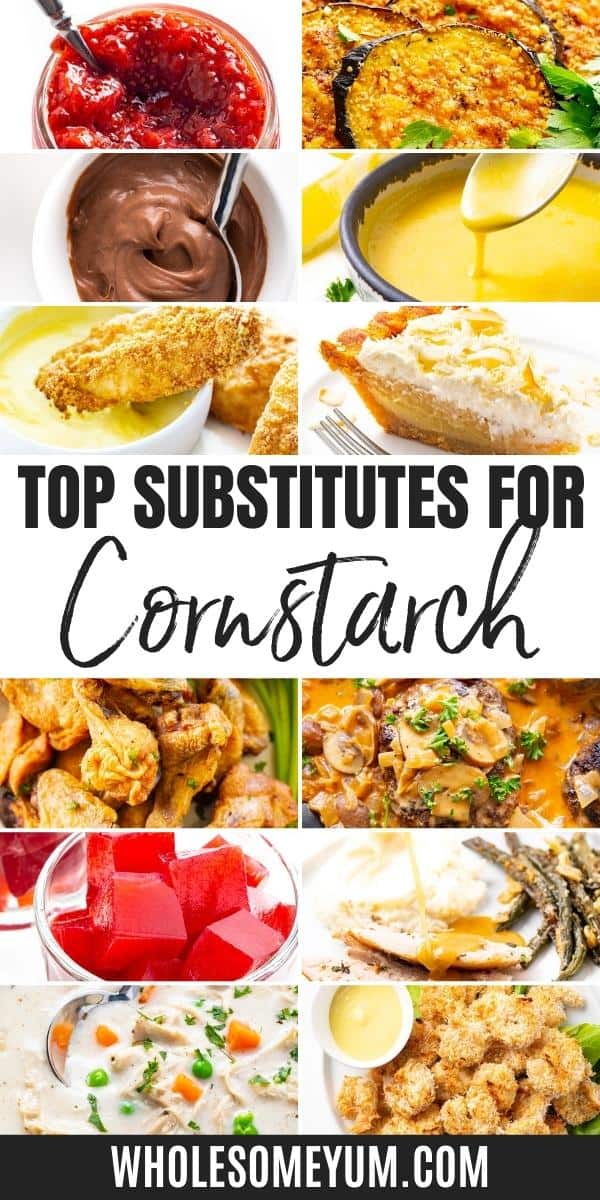
- Pork Rinds – Crushed pork rinds make everything ultra crispy. I use about 1/4 cup per tablespoon of cornstarch. Try them in my low carb chicken tenders (pictured below) or keto fish sticks.
- Parmesan Cheese – Parmesan adds a golden crust and a savory kick. I use about 1/4 cup for each tablespoon of cornstarch, and it works especially well in my air fryer eggplant. More often, though, I find it works better mixed with something more crispy, like breadcrumbs or almond flour.
- Almond Flour – For a similar browned, breaded feel without the carbs. I use this one very often, about 1/4 cup for every tablespoon of cornstarch. It works great for fried zucchini!
- Whey Protein Powder – Of the many protein powders I’ve tried, whey creates the best crunchy crust for frying. Egg white protein, collagen, and plant-based proteins all cook up chewier. I start with 3 to 4 times the amount of cornstarch, and always go for unflavored.
- Coconut Flour – This cornstarch alternative soaks up moisture fast, so it’s great for dredging, more so than actual breading or batter. I use it 1:1 for cornstarch for this purpose, like in my coconut shrimp, but it’s never 1:1 in other situations.
- Baking Powder – Baking powder helps fried foods crisp up by raising the surface pH, creating air bubbles, and giving more surface area. I use 1/2 tablespoon for every tablespoon of cornstarch, and it works especially well on air fryer chicken wings.

Substitutes For Cornstarch In Sauce
The fine granules in cornstarch expand when added to liquid slurries and sauces, causing them to thicken. I’ve achieved a similar effect with these cornstarch slurry substitutes.
General Alternatives For Thickening:
- All-Purpose Flour – Flour won’t give you that glossy finish like cornstarch, but it still thickens sauces just fine. Substitute 2 tablespoons of flour for every 1 tablespoon of cornstarch, and allow it to cook slightly to eliminate any raw flavor. It works in gravies, pie fillings, or anything saucy.
- Rice Flour – Just like all-purpose flour, you’ll need double the amount. It’s a great option if you want to thicken a clear sauce without clouding it up.
- Potato Starch – Use about 1 to 1 1/2 tablespoons of this for every tablespoon of cornstarch. I add it toward the end of cooking and keep the heat low so it doesn’t break down.
- Tapioca Starch – One of my favorite cornstarch substitutes lately — I use it in my gluten free gravy! It also works especially well in recipes with long and low cooking times, such as slow cooker recipes. Swap in 2 tablespoons for each tablespoon of cornstarch.
- Arrowroot Powder – This is my go-to clean-ingredient cornstarch substitute for thickening! I use 1 to 1 1/2 tablespoons as a swap. Try it in my creamy sun-dried tomato chicken (pictured below).
Healthy & Low Carb Alternatives For Thickening:
- Heavy Cream – This won’t thicken the same way as cornstarch right away, but simmer it a little longer and it reduces into a rich, creamy sauce. I usually start with 3-4 tablespoons per tablespoon of cornstarch.
- Butter – Perfect for finishing pan sauces. I stir in 3-4 tablespoons off the heat to add richness and body without breaking the sauce.
- Egg Yolks – These are great for creamy sauces like hollandaise or custards. Use 2 egg yolks in place of 1/4 cup of cornstarch.
- Chia Seeds – Chia thickens into a gel and works well in things like sugar-free jam. I use 2 tablespoons of chia seeds for every tablespoon of cornstarch.
- Guar Gum – A little goes a long way. I use 1/8 teaspoon of guar gum for each teaspoon of cornstarch. It’s great in dairy-based sauces and even ice cream.
- Xanthan Gum – This is a staple for low carb sauces. I use 1/4 to 1/2 teaspoon for every tablespoon of cornstarch. It can clump, so mix it into a small amount of liquid first before adding it to the full recipe.
- Gelatin Powder – Gelatin can create a soft set at low concentrations (like in keto gravy), a medium one (like in sugar free jello), or a firm gel when used in larger amounts (like in sugar free gummies).
- Pureed Veggies – One of my all-time favorite methods for thickening soups and even sauces! Just blend cooked zucchini, cauliflower, or broccoli to add natural thickness, then return the puree to your dish. Try it in action in my broccoli cheese soup and creamy chicken soup!
- Cream Cheese – This melts smoothly into broth-based recipes, like my chicken pot pie soup or salisbury steak. I add 3-6 tablespoons per tablespoon of cornstarch, stirring it in gently over low heat. Sometimes, blending is helpful to get it super smooth.

Cornstarch Alternatives For Other Uses
Not every cornstarch substitute works the same in every recipe. Here are the ones I’ve found work best for common uses beyond baking, sauces, and frying:
- Pudding – Cornstarch helps pudding thicken without clumping, but unflavored gelatin does the job, too. I use it in my low carb chocolate pudding and it sets up beautifully.
- Pie Filling – For that classic gelled texture, gelatin or egg yolks are great stand-ins. You’ll see both in recipes like my keto apple pie and coconut cream pie.
- Marinating Meats – In marinades, cornstarch will tenderize, create a protective coating before cooking, and thicken the final dish. For a similar result, I’ve marinated meat with skin on using acidic ingredients (such as my cilantro lime chicken), or toss meat with gelatin before marinating and cooking (like my slow cooker Mongolian beef).
- Thickening Soups – Cornstarch makes soups thick and spoonable. You can use any of the cornstarch alternatives for thickening above, in recipes like roasted cauliflower soup or bacon cheeseburger soup.
- Jams And Jellies – Instead of cornstarch, I like to use gelatin or chia seeds for a cleaner set. You’ll find gelatin in my blackberry jelly and chia seeds in my strawberry chia jam.

Common Substitution Questions
- Can you substitute flour for cornstarch? You usually can, but the results will be a little different. Flour won’t get fried foods quite as crispy, though it still browns nicely. Wheat flours are better for thickening, but I prefer nut flours for breading or frying.
- Can you substitute arrowroot for cornstarch? Yes, it’s a close swap, and the one I use most often for a cleaner alternative. But, it doesn’t hold up as well in recipes with a lot of dairy. Also, sometimes you may need to use a bit more arrowroot than cornstarch.
- Can you substitute potato starch for cornstarch? Yes, potato starch makes a good cornstarch substitute for baking, frying, and thickening. If using it to thicken, though, be sure to add it shortly before serving your dish and avoid heating it at high temperatures.
- Can you substitute cornstarch for baking powder? Not usually. Baking powder helps baked goods rise, while cornstarch thickens, so they’re not interchangeable. The only exception is to get crispy skin on chicken, for this purpose both work.
- Can you substitute cornstarch for tapioca starch? Yes, especially in recipes that need thickening. You’ll usually need twice as much tapioca starch to get the same result as cornstarch.
- Is there a keto substitute for cornstarch? Yes, there are many keto cornstarch substitutes for frying, baking, and thickening — see my suggestions above for each! Just check carb counts and substitution ratios to keep your recipes keto friendly.
The Best Substitutes For Cornstarch









29 Comments
Patricia Clayborn
0Is there a printer friendly version of this blog available?
Maya | Wholesome Yum
0Hi Patricia, This list isn’t currently available as a PDF. You can create a free Wholesome Yum accountt and use the heart button to save the article and refer back to it when needed.
Andrew Powell
0I just got schooled unfortunately I’ve been diagnosed with diabetes and have to come up with alternatives I would have spent a whole day researching this information and it was all right in front of me thank you.
Druski
0Hi; I want to try a recipe for Air Fryer Crispy Tofu, and every example I find pretty well has Cornstarch. I am doing Keto and I am looking for a low or No carb alternative. Would either Kraft grated parmesan cheese or Whey Protein Isolate powder work well in that recipe as shown? (or even a mixture of the two?).
Maya | Wholesome Yum
0Hi Druski, Any of the options I listed under breading should work. You might want to just grab one of my other breaded recipes depending on which breading you want, and then use that on tofu. Enjoy!
Jennifer
0So I’m looking to make homemade “cream of” powdered soup mix. I found a recipe that calls for: 2 cups of dry powder milk 3/4 cup of cornstarch. I’m trying not to use cornstarch and want to try xantham gum instead. My question is would I do a 1:1 in this case or much less? I’ve never used it before and any help would be great! Thank you!
Maya | Wholesome Yum
0Hi Jennifer, It might be tough to replace with a low carb option for a recipe that calls for so much cornstarch. You can try xanthan gum but would need much less. The conversion would be about a teaspoon of xanthan gum, but even then the texture might be off. Let me know how it goes if you try it!
Lillian Brim
0I’m making a Lemon Meringue Pie and don’t have any corn starch what can I use?
Maya | Wholesome Yum
0Hi Lillian, There are many alternatives listed in the post, but more specifically, you can make my sugar free lemon meringue pie, which does not use any cornstarch. Enjoy!
Karen
0Just got an ice cream maker and am looking for a substitute for cornstarch to make gelato. Any suggestions?
Maya | Wholesome Yum
0Hi Karen, Tapioca starch or arrowroot powder should work as cornstarch substitutes in gelato.
Bonnie
0What can I use to bake sweet potato fries?
I have almond flour. Would that work in place of corn starch?
Wholesome Yum D
0Hi Bonnie, I am not sure what you’re asking, as I have never used either almond flour or cornstarch to bake sweet potato fries.
Lori M.
0Great to have so many of the options explained in one place! With usage and function descriptions no less, since it is so true – there is no single best swap. However, there have been important new techniques and ingredients in the last several months in the ketoverse. In particular, Spherification-related sodium alginate (gravies) and tara gum (ice cream) so I hope you all can jump back into the topic and provide your understanding soon. Also, there is no evaluation of how “clean” an option is (like arrowroot) or if an option is lower carb than usual (xanthum gum or guar gum). I know its a lot of info, maybe a table could help. Thanks again!
Roberta
0I’ve recently read about potato FIBRE (not starch, nor flour) in particular for baking bread, focaccia, but also for pancakes and of course gnocchi limiting the net carbs (actually being it just the fiber without the starch is basically 0 carbs): it was described as highly adsorbant and giving a nice texture to tha batter taking it to the next level near the “real one” which is always what we aim for 😉 Did you try it? Would appreciate your expertise consideration about this new -here in EU used by more and more people- resource, with others options like bamboo fiber and or oat fiber (certified gliuten free), the latter being already known and tested also there in Canada and USA in many recipes I’ve found…
Thank you for your your effort to share your experience with us.
Wholesome Yum D
0Hi Roberta, Unfortunately, I have never attempted to use this ingredient so I currently cannot give you any insight.
Lori M.
0I’ve seen that there are white papers on the topic but not the product in the US. However potato fiber is used in Catalina crunch “cereal” for humans and pet food. There are market growth analyses for 2019-2026 – hopefully we’ll have it as a product in the not too distant future.
Beth Dreves
0Can you make the CORNSTARCH SUBSTITUTES info printable please?
Maya | Wholesome Yum
0Hi Beth, This list isn’t currently available as a PDF. You can create a free Wholesome Yum accountt and use the heart button to save the article and refer back to it when needed.
Sandra
0I’m confused here. So many of the substitutes are not Keto. such as flour. Regular flour contains wheat, which is a no-no. Your comments, please. Thank You. Sandra W.
Wholesome Yum D
0Hi Sandra, This is a general list, broken down into regular and low carb options.
Robert
0Outstanding list! Wish it had a “print” button 🙁
Wholesome Yum D
0Hi Robert, This is not something I currently have but I suggest saving the post using the heart (top bar on mobile or left floating buttons on desktop), so you can easily refer back to it.
kdbd7197@gmail.com
0I love low carb recipes from you!!!
Fan
0Great resource. Thanks. Would love to get it as FREE PRINTABLE DOWNLOAD (pdf). Thanks for everything !
Wholesome Yum D
0Hi Fan, This is not something I currently offer but you can save the post using the heart (top bar on mobile or left floating buttons on desktop), so you can easily refer back to it.
Jacki Fisher
0THANK YOU, MAYA! This is a wonderful resource for all. Thank you for taking the time for your research and posting. Most Helpful.
Allen Rosendahl
0I would like to save or print your article on cornstarch alternatives. I don’t use social media and I don’t like using Google or other media to save anything online. I’m using an iPad so how do I save this article? I bought your printed cookbook and also another cookbook I thought would be a printed version but it’s not so I will have to find where I can get to that.
I have the printed keto food list.
Wholesome Yum D
0Hi Allen, I recommend making a Wholesome Yum Account. You will then be able to save recipes and articles to your account. At the top of the page of each article, you will see a heart with the word save, you would click that to add them to your account.