
 Shop
Shop My
My Custom




Free Printable: Low Carb & Keto Food List
Get It NowMy Almond Flour Pizza Crust Makes The Easiest Crispy, Healthy Pizza

I’ve made many healthy pizza recipes over the years, but this almond flour pizza crust is by far my oldest and simplest, from way back in 2016. I originally created it as a more nutrient-dense throwback to the crispy frozen pizzas from my college days.
More recently, I made a few minor adjustments. I started using olive oil instead of coconut oil, and swapped a little of the almond flour with tapioca flour — and I think it’s even better now. Here’s why I still keep coming back to this healthy pizza crust:
- Thin, crispy crust – It’s got some serious crunch, so only make it if you love your crusts crispy! And I love that it tastes neutral, so it’ll work with any toppings you love.
- Just 4 ingredients – Plus salt. I used to make this almond flour pizza crust recipe with 3, but recently added a fourth and the texture is even better.
- Easy to make – The dough comes together in one bowl (hi, busy weeknight!), is quite easy to work with, and can even be made ahead. It’s an easy weeknight meal all by itself, or pair it with my creamy cucumber salad, zucchini noodle salad, or artichoke salad.
- Actually good for you – This recipe is gluten-free, dairy-free, naturally low in carbs, and packed with protein from eggs and healthy fat from olive oil and almonds. I feel so much better eating it than a regular white flour crust.
If you’re craving pizza with a thin, crispy, and healthy pizza crust without much fuss, this is the one. Make it with me!

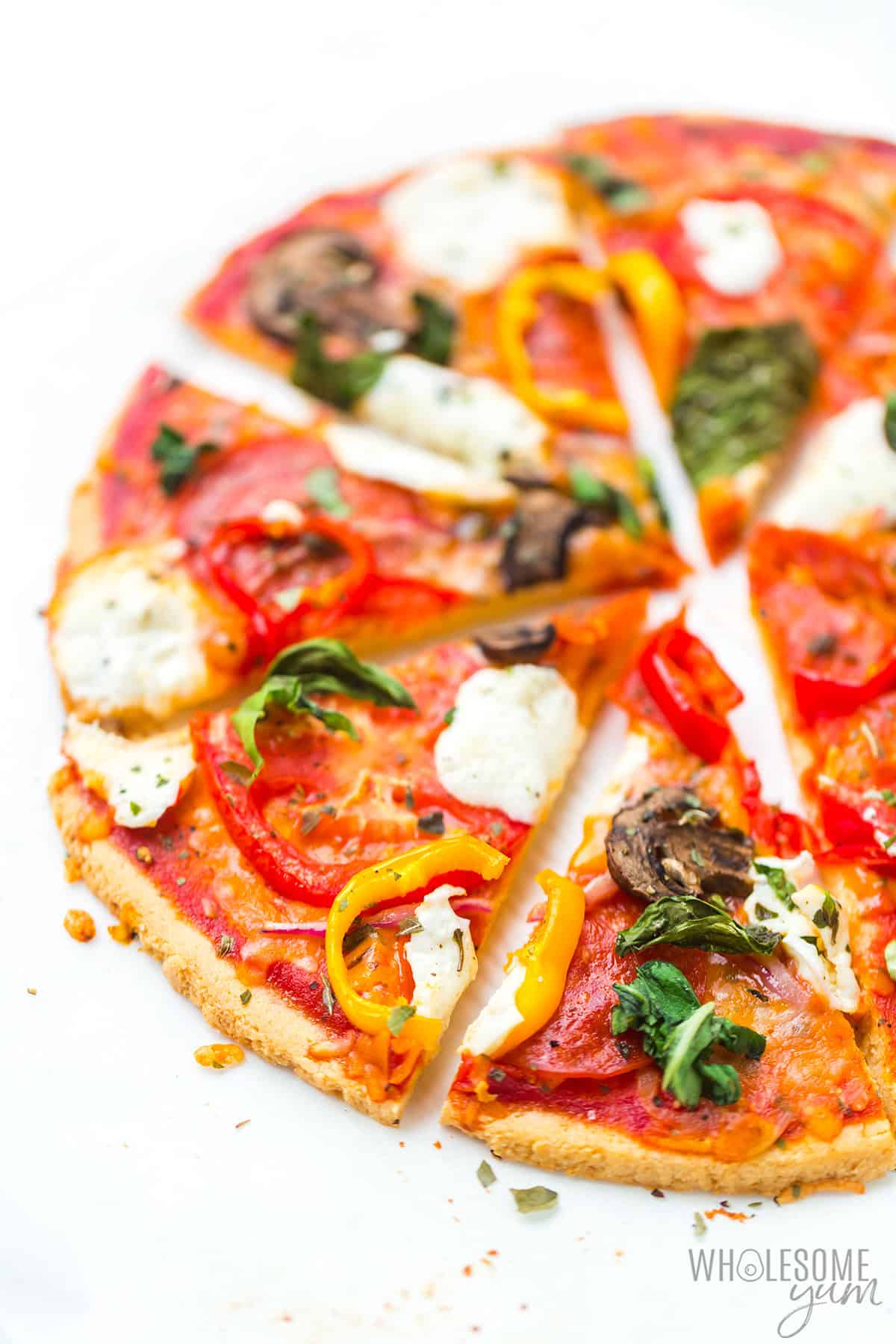
“I loved it! I cooked mine in a cast iron pan, yes I used parchment paper. I love the crust as it has a little crunch. I also love the fact there are minimal ingredients! I’ll definitely make this again!”
-Michelle
Ingredients & Substitutions
Here I explain the best ingredients for my healthy pizza crust recipe, what each one does, and substitution options. For measurements, see the recipe card.
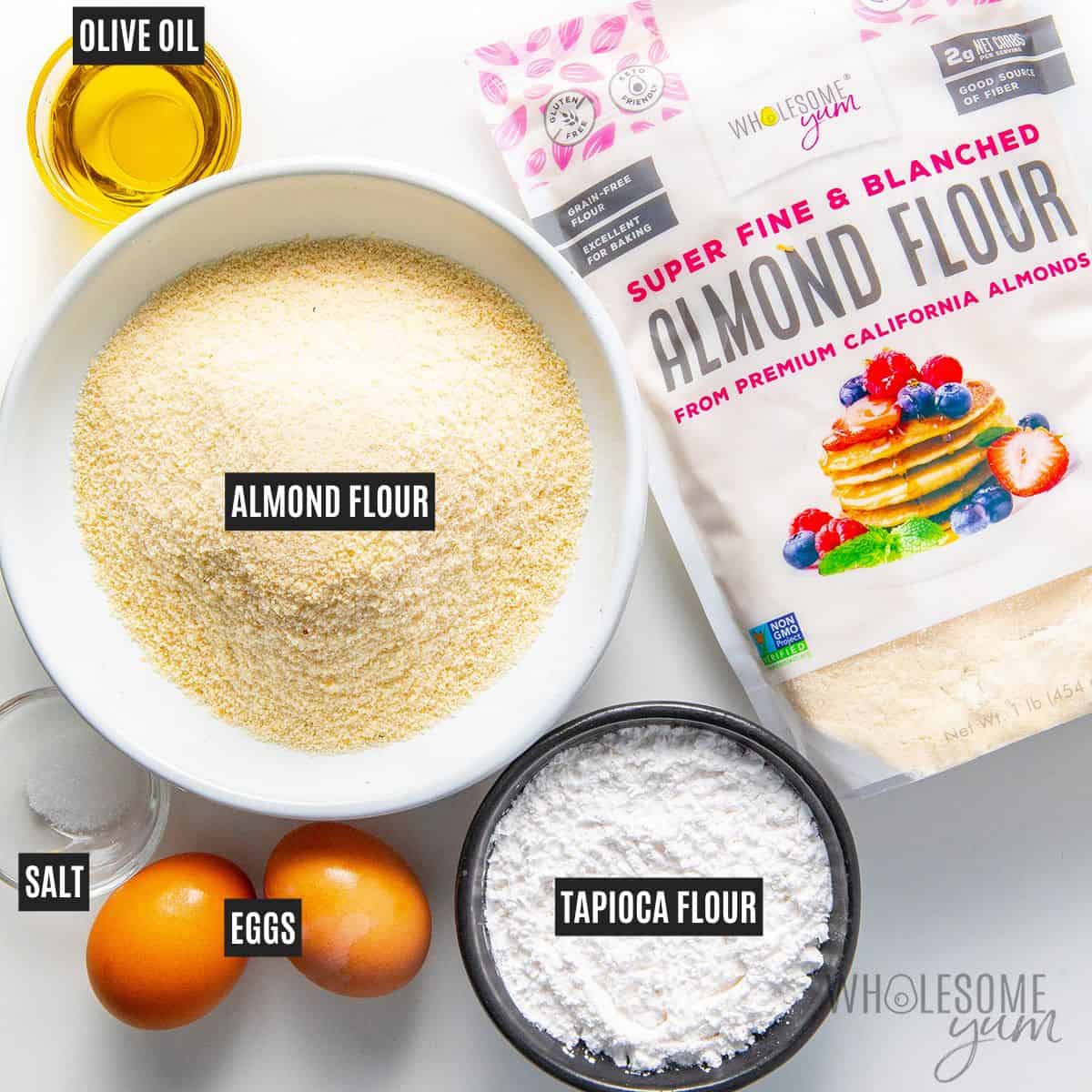
- Wholesome Yum Blanched Almond Flour – I don’t recommend substituting anything else, as it’s the main ingredient, and the brand makes a big difference. This is the only one I use because it’s ground much finer than others. I used to make this recipe with other brands before I made my own, and the results were often too grainy. Almond meal will be the worst in that department, but even blanched ones can be inconsistent.
- Tapioca Flour – This is a relatively recent addition, sometimes called tapioca starch. I replaced 1/2 cup of almond flour in my original almond flour pizza crust recipe with this tapioca flour, which made the texture just a little chewy but still crispy. You can use more almond flour instead if you want extra low carbs.
- Olive Oil – My recent fave is this one. I used to make this crust with refined coconut oil, which is flavorless, but now prefer olive oil. Either is fine. If you are not strictly dairy-free, you can use ghee. I don’t recommend using unrefined coconut oil, as you’ll taste the flavor.
- Eggs – For binding. You might be able to use an egg substitute, such as flax eggs, but it won’t be as sturdy.
- Sea Salt – For balance. If you want to cover up the almond flour flavor more, I recommend adding dried herbs (such as Italian seasoning mix, dried basil, or dried oregano) and garlic powder.
How To Make Almond Flour Pizza Crust
I have step-by-step photos here to help you visualize the recipe. For full instructions with amounts and temperatures, see the recipe card.
- Mix the dry ingredients. In a large bowl, combine the almond flour, tapioca flour, and salt.
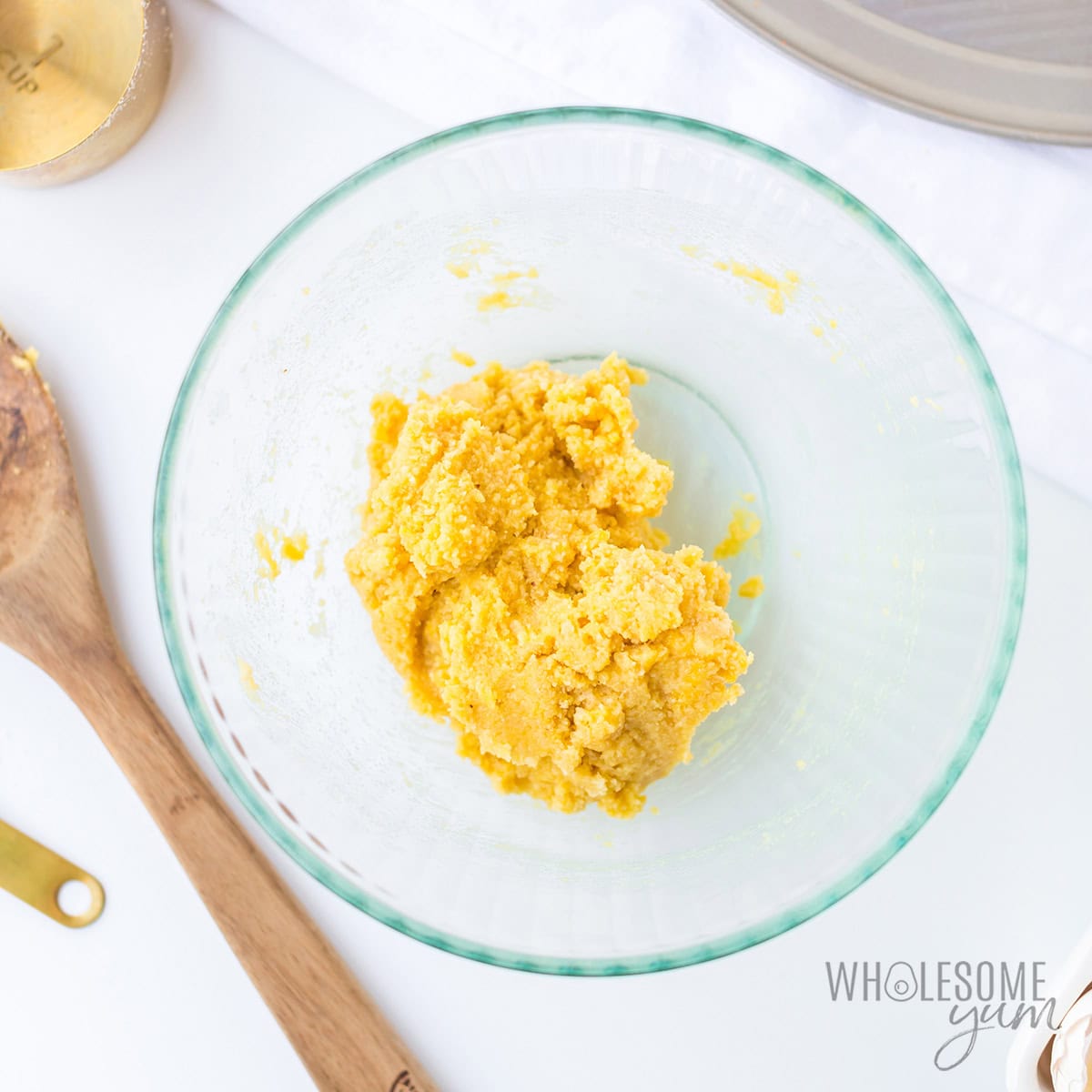
- Add the olive oil and eggs. I usually add these after mixing the dry ingredients, but in the picture below, I just added everything at once. Mix well until a dough forms.
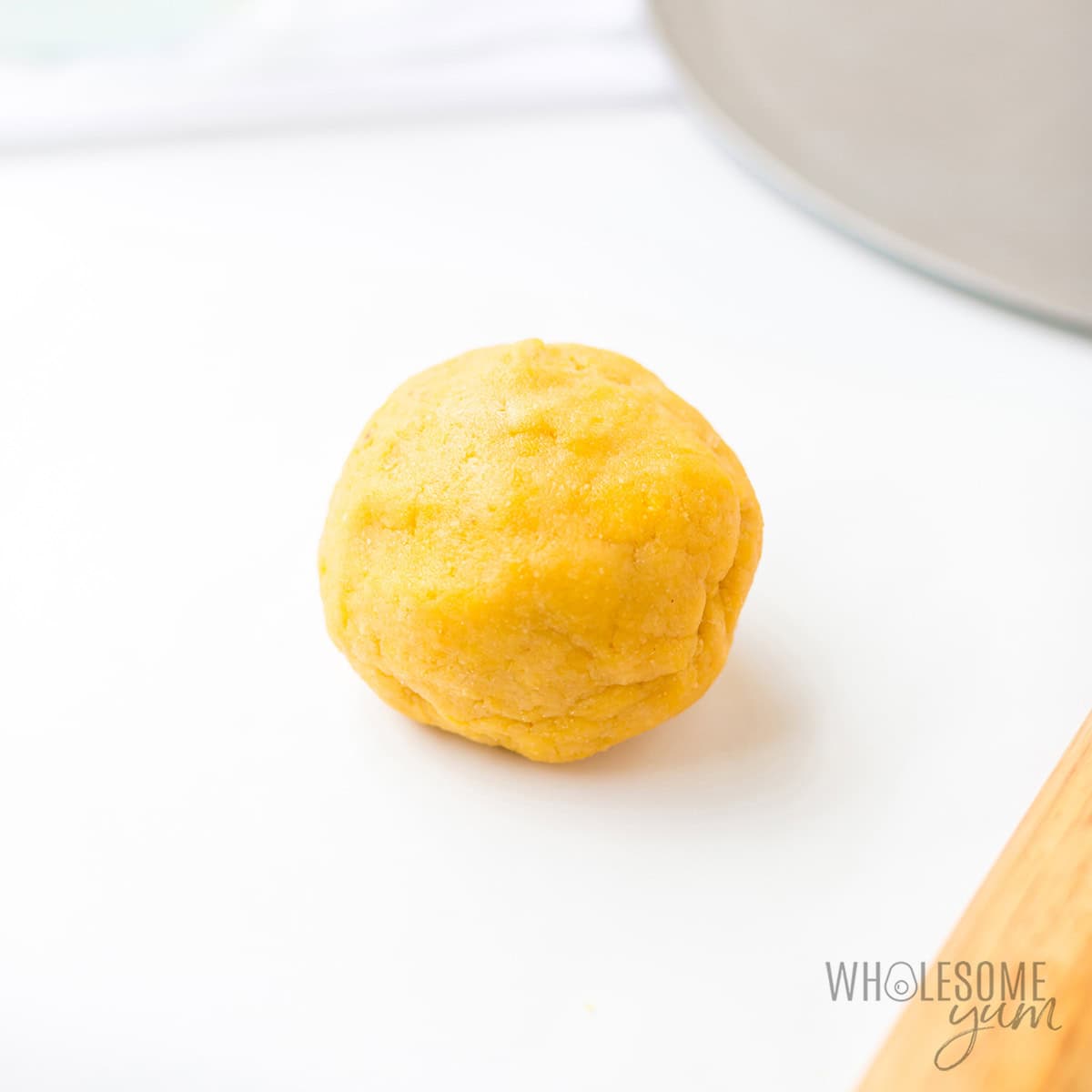
- Form the dough into a ball. It’s usually pretty easy to work with, but if your kitchen is humid and you find it’s sticky, it’s helpful to pop it in the fridge for 20-30 minutes to firm up. I also have more tips below for working with sticky dough.
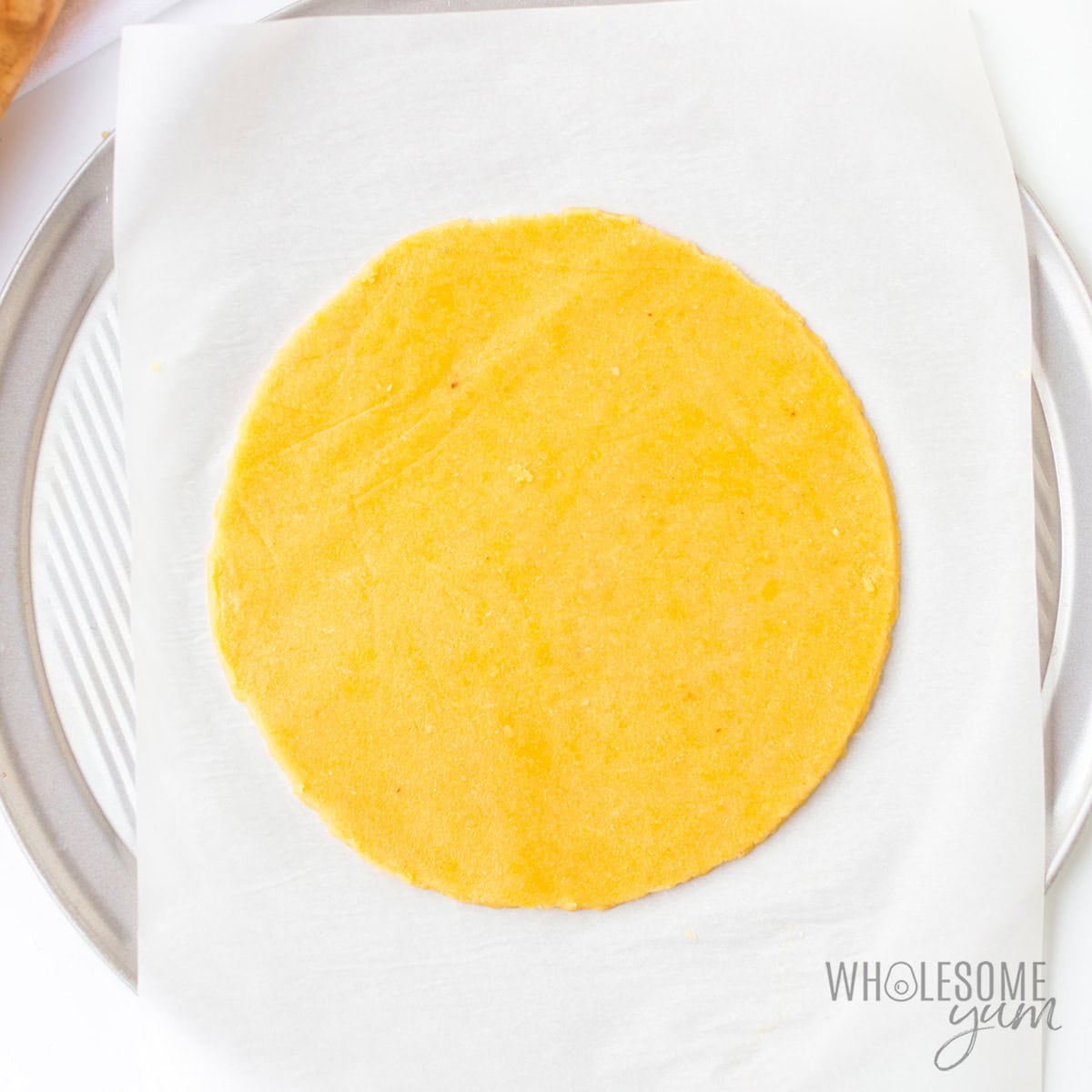
- Roll it out. Place the ball between two pieces of parchment paper, then use a rolling pin to roll out a circle, 1/4 inch thick. I usually get a crust about 10 inches in diameter with this thickness.
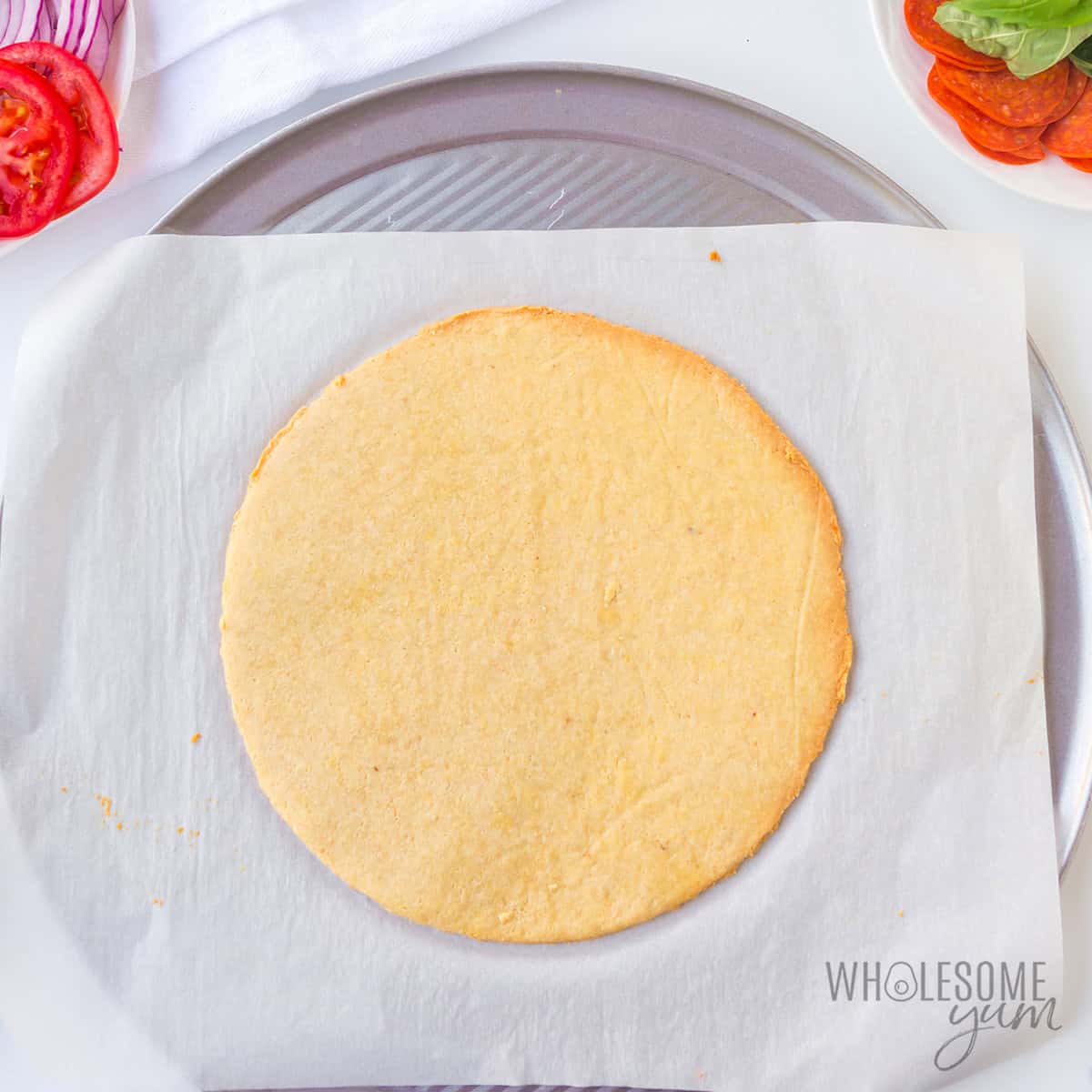
- Bake the almond flour pizza crust. Transfer it to a pizza pan (right on the parchment paper), or if using a pizza stone, use a pizza peel to slide it onto the stone in the oven. I used this pizza pan below, but usually prefer my pizza stone for a crispier crust texture.
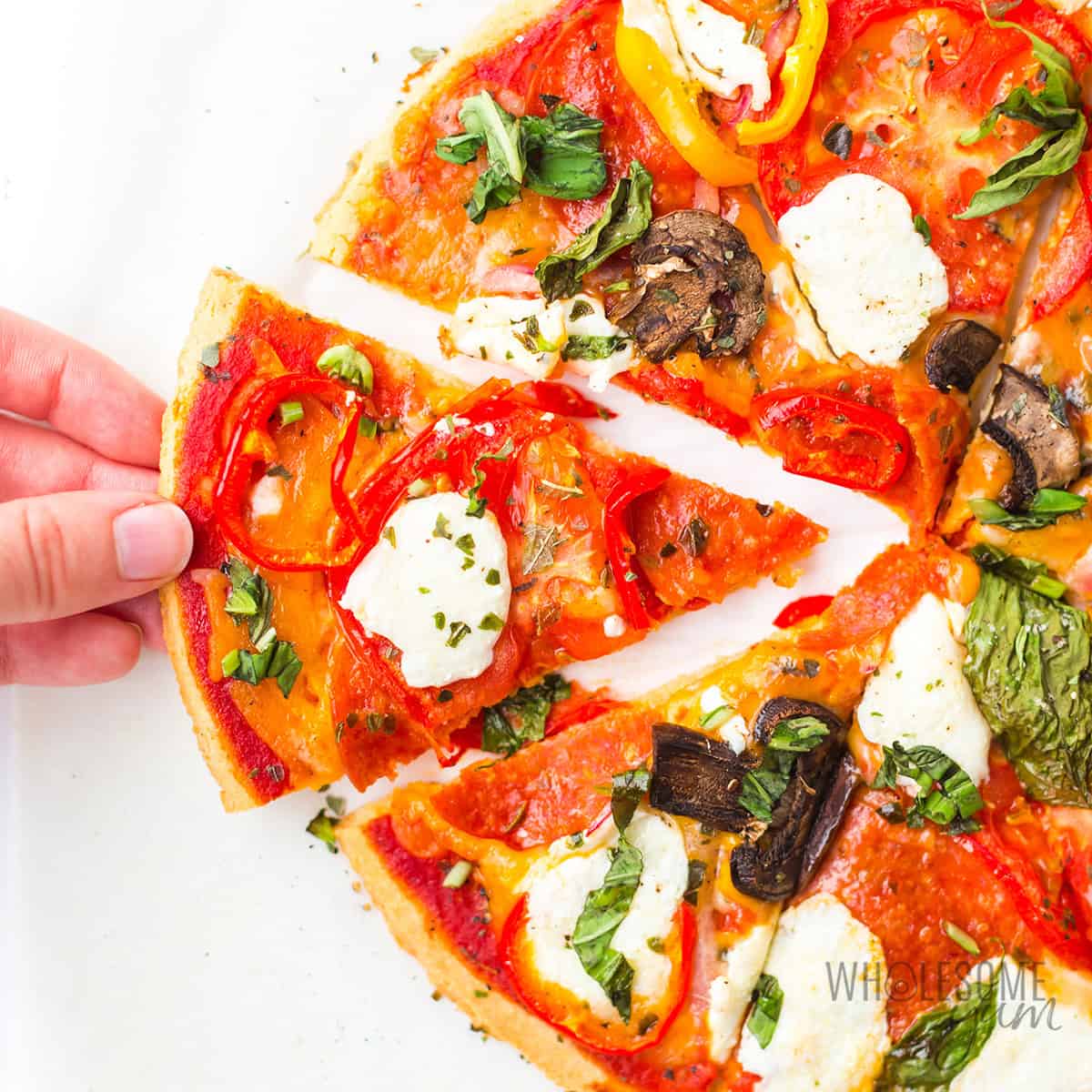
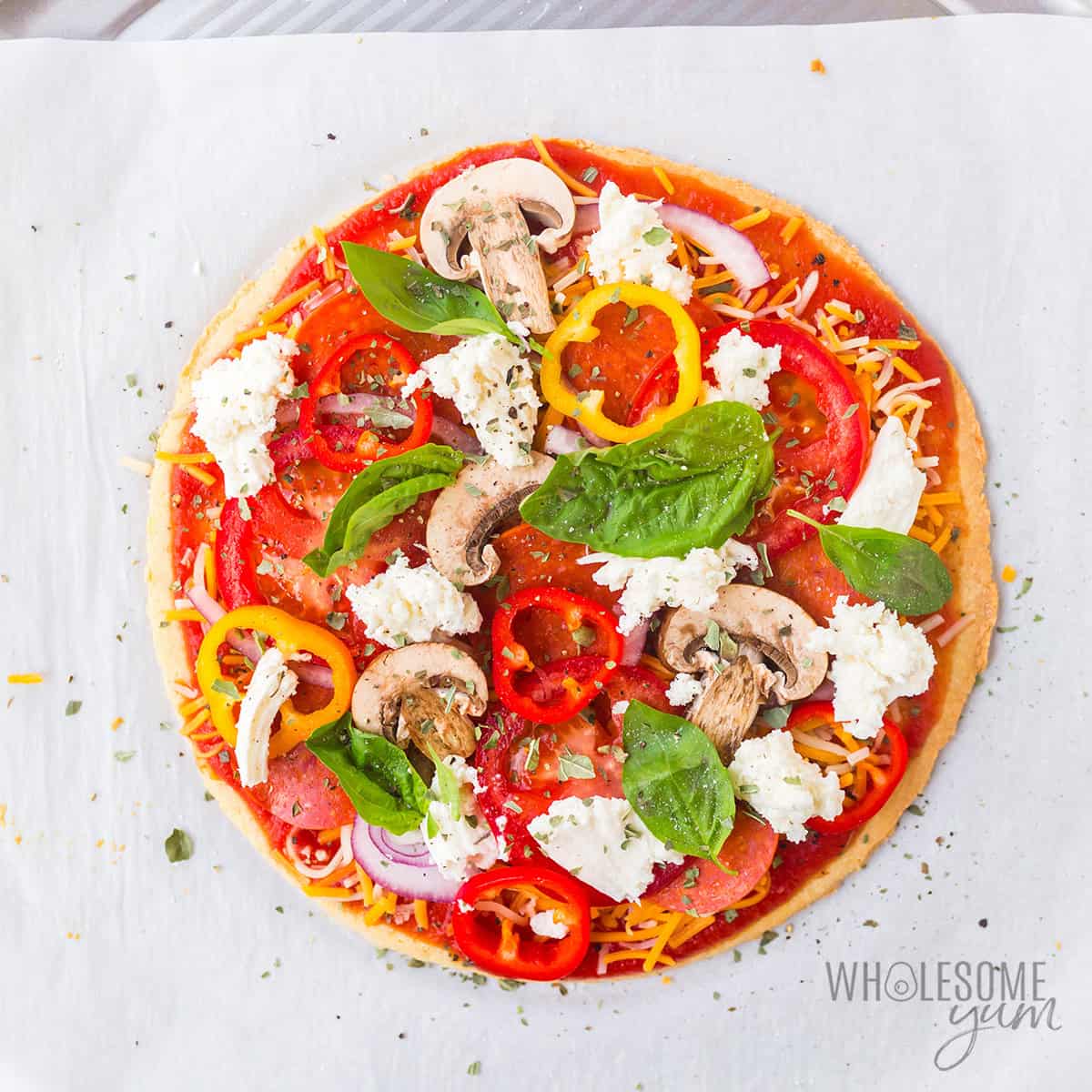
- Add sauce and toppings, and bake again. I added mushrooms, bell peppers, red onion, fresh basil, and a little goat cheese. You can skip the cheese for paleo or dairy-free. Alternatively, leave crust plain, let it cool, and refrigerate or freeze for later.

My Recipe Tips
- To mix the dough faster, use a food processor. I usually do it by hand in a bowl instead (less dishes to wash!), but it does help if you need dinner on the table quickly.
- How to handle sticky dough: Chilling the dough in the fridge has the biggest impact, like I mentioned above. Sometimes, I find it helps to spray the parchment paper with olive oil spray, and use this marble rolling pin, which stays cool better than wood.
- The thickness you roll this almond flour pizza crust recipe is important. If it’s not all the same thickness, it won’t bake evenly. The baking time can also vary even with slight differences in thickness, so I always recommend checking on it a little sooner.
- You can spread the dough by hand, but it’s not easy. That’s because you have to get it very thin for the best texture, and it can be a challenge to get an even thickness that way.
- Prick crust with a fork to prevent bubbling. I skipped this in my pictures above and it turned out okay, but I get more consistent results if I do this step.
- A pizza stone gets you a better texture than a pizza pan. I have this pizza stone. Since you have to preheat it together with your oven, you’ll also need a pizza peel to slide the crust onto the stone.
- Don’t let the crust edges get too dark during the first bake. You want the crust firm but not very golden at this point. The edges will get darker when baking with toppings. If they do get golden upfront, I find it helps a little to cover them in foil before you bake again.
- For the second bake, you can place the almond flour pizza directly on the oven rack or pizza stone. You’ll still need to bake the raw crust on parchment paper to prevent sticking. After adding the toppings, I get a crispier result without the paper.
- Watch closely while baking. This includes both the parbake and the later one. Once the crust starts to burn, it progresses quickly.
- Need topping ideas? I have over a dozen combos between my keto pizza and cauliflower pizza posts — the same toppings can be used on this almond flour pizza crust, too!

Almond Flour Pizza Crust
My healthy almond flour pizza crust recipe is thin, crispy, and easy to make with just 4 ingredients. Add your favorite toppings and enjoy!


Instructions
Tap on the times in the instructions to start a kitchen timer.
-
Preheat the oven to 400 degrees F (204 degrees C). If using a pizza stone, place it on the middle rack before preheating.
-
In a large bowl, whisk together the almond flour, tapioca flour, and salt. Add the olive oil and eggs. Mix all the ingredients together until a dough forms (you can use a food processor or mix by hand).
-
Compact the dough into a ball. Place the ball between two pieces of parchment paper, then use a rolling pin to roll out a circle about 10 inches in diameter and 1/4 inch (0.6 cm) thick.
-
Remove the top piece of parchment paper. Poke the crust a few times with a toothpick to prevent bubbling.
-
Transfer the crust on the parchment paper to a pizza pan, or if using a pizza stone, use a pizza peel to slide it onto the stone in the oven.
-
Bake for 10-12 minutes, until the almond flour pizza crust is firm but not yet golden.
-
Remove the crust from the oven. Add sauce and your favorite toppings. Return the almond flour pizza to the oven for about 10 minutes, this time directly on the pizza stone, without parchment paper. It's done when the cheese is melted, and the edges of the crust are golden brown.
Did You Like It?
Leave a rating to help other readers (this also helps me continue to provide free recipes on my site), or get the recipe sent to your inbox.
Maya’s Recipe Notes
Serving size: 1 slice, or 1/8 of entire recipe
- Tips: Check out my recipe tips to help you work with this dough and get the perfect texture in your almond flour pizza crust. I also have texture variations below.
- Storage: Cool the pre-baked crust completely, wrap tightly, and store in the refrigerator for up to a week. You can also keep leftovers in the fridge for up to 2-3 days, they don’t last as long since the sauce will start to make the crust soggy.
- Reheat: Add toppings and bake as usual. If you’re reheating already topped pizza, I recommend 350 degrees F instead.
- Freeze: You can wrap and freeze a plain crust for up to a year, or assembled pizzas for up to 3 months. If you add the sauce and toppings, freeze immediately. Bake from frozen — do not thaw first.
📖 Want more recipes like this? Find this one and many more in my 30 Dinners In 30 Minutes and Keto Ebook Bundle!
I provide nutrition facts as a courtesy. Have questions about calculations or why you got a different result? Please see my nutrition policy.
Add Your Notes Your Notes
Try More Of My Recipes


© Copyright Maya Krampf for Wholesome Yum. Please DO NOT SCREENSHOT OR COPY/PASTE recipes to social media or websites. We’d LOVE for you to share a link with photo instead.
Healthy Almond Flour Pizza Crust Recipe
Texture Variations
The texture of this healthy pizza crust is different from traditional versions. I’ve got tips to help you make it the way you like:
- For a crispy texture: This crust naturally comes out crisp, but for extra crispness, roll it out as thinly as possible. I aim for about 1/4 inch thick. Thick crusts take longer to bake and you’ll detect more of the almond flour flavor if you make it thicker.
- For a chewy texture: I recently added tapioca flour to the base of this almond flour pizza crust recipe, which helps add a little chew. To make it even chewier, mix 1/4 to 1/3 teaspoon of xanthan gum with the other dry ingredients. You can also add gelatin — mix a tablespoon with a bit of water first, let it thicken for a few minutes, then use a hand mixer or food processor to incorporate into the dough.
More Healthy Pizza Recipes
Healthy pizza crust is my jam, so I’ve got lots of lighter ways to enjoy pizza! Try one of my others next:















421 Comments
Daniel
0Looks delish!!! Does it need the sea salt added? I’m trying to reduce sodium and was wondering if I could just use some herbs in substitution.
Maya | Wholesome Yum
0Thank you! To me the sea salt adds flavor but it’s not absolutely required. (It’s only for taste, but not texture or other aspects of the recipe.) If you want to keep the same flavor, you could also use potassium chloride as a substitute to avoid sodium. And, I do love adding herbs to this crust, especially Italian seasoning.
Ada
0I made this today, and it was perfect! Thank you!
Maya | Wholesome Yum
0Thank you, Ada!
Sharon Campbell
0I can’t afford almond flour but I did make almond meal. My blender won’t make it fine like flour. Will it ruin the recipe? I just copied them by hand , all of them! Thanks, sure hope I can make them.
Maya | Wholesome Yum
0Hi Sharon, The texture will be a little different but you can still make this pizza crust with almond meal. I do prefer it with almond flour, but I’d still rather make it with almond meal than not at all. 😉
Kelly
0I would try looking for a garlic flavored oil. Grape seed oil is also very healthy compared to coconut oil.
Maya | Wholesome Yum
0Hi Kelly,
Adding garlic to the pizza crust sounds delicious! I would opt for either garlic powder or crushed garlic.
However, I wouldn’t advocate grape seed oil as healthier than coconut oil (or healthy at all). Grape seed oil is usually highly processed and extracted using a chemical called hexane. Most of the beneficial components found in grape seeds are not actually found in the oil (source). In addition, it’s primarily made up of omega-6 fatty acids, which have been linked to disease when we consume too much of them (sources here and here). Since this recipe already contains almond flour, and almonds are high in omega 6’s, I wouldn’t use an oil that is also high in these.
On the other hand, benefits of coconut oil include fighting infection, reducing appetite, and improving blood cholesterol levels, among others (sources here, here, and here). The link between saturated fat and heart disease was disproven as well https://pmc.ncbi.nlm.nih.gov/articles/PMC9794145/” target=”_blank” rel=”nofollow”>source). So, don’t be afraid to use coconut in the recipe. 🙂
Cheryl
0May sound silly, but I don’t see the serving size. Is it the whole pizza?
Maya | Wholesome Yum
0Hi Cheryl, The serving size is one slice, which is 1/8 of the pizza.
Jeana Brown
0This was great! I used ghee in place of coconut oil and garlic salt in place of salt. I also added some Italian seasoning. It was yummy!!!
Maya | Wholesome Yum
0Thank you, Jeana! I’ve made it with those swaps too and agree it’s great that way.
Julie
0Do you recommend freezing the crust before it’s cooked?
Maya | Wholesome Yum
0Good question! No, there is no need to freeze it unless you want to just have one in the freezer ready to go. Otherwise, you can just add the toppings immediately after making the crust and return to the oven right away.
Priscilla Gonzalez
0If you cook the crust but aren’t going to cook w/toppings for about 1 hour, can you just refrigerate it after it cools?
Maya | Wholesome Yum
0Hi Priscilla,
Yes, you can refrigerate it, but for that amount of time you could leave it on the counter as well. Before adding the toppings, it’s about as stable at room temperature as any other baked goods (breads, cookies, whatever), so should be fine sitting on the counter for an hour (or more) until you are ready to add toppings.
I wouldn’t recommend adding toppings ahead of time (especially the sauce), because the crust won’t stay crispy if it sits with the sauce on it for a long time. I make the crust itself ahead all the time, though. 🙂
Danielle
0Maya… Finding your blog has made my day! My hubby is newly diabetic, and so we are trying to change our eating lifestyle. But I have been a professional baker for 17 years, and a life without bread and dessert… thank you for your recipes! I am so excited to try them all!
Maya | Wholesome Yum
0Thank you so much, Danielle! I’m so glad the recipes are helpful for you. That means so much coming from anyone, but even more so from a professional baker!
Deb
0Maya, I found your 4 ingredient pizza crust recipe. You don’t say how much oil or butter to use. My grandson was just diagnosed, and needs to be gluten-free. And he loves pizza!!! If you could let me know the amount I’d be very grateful. Thanks.
Maya | Wholesome Yum
0Hi Deb, The amount is listed on the recipe card – 2 tablespoons of coconut oil or butter. Hope this helps!
Jenn
0Excited to try this. 🙂 Thanks!
Susan
0Better yet, try avocado oil! I have not tried the recipe yet, but I love the coconut flavor. I’m excited to make this, the tortillas, and the bread! Thanks a lot for all the great tips! ❤
Maya | Wholesome Yum
0Hi Susan, You’re welcome and I’m so glad you’re looking forward to trying the recipes. I love avocado oil and use it all the time, but for this recipe I recommend either coconut oil or butter (oils that are liquid at room temperature act differently). If you do try avocado oil I’d be curious to hear how it goes.
Elizabeth
0How are oils at room temp different? I used olive oil and it was super dry, is that the differ?
Maya | Wholesome Yum
0It might be. I haven’t tested it with every type of oil, only know that oils that are solid at room temp will not interact the same way as oils that are liquid at room temp. For this recipe you need either coconut oil or butter.
Jordan Sanabria
0This recipe is 3g carbs for the whole crust, right?
Maya | Wholesome Yum
0Hi Jordan, The nutrition facts are per serving (1/8 of the pizza crust).
Claudia
0Well, I live in the UK and did not know we had de-fatted almond flour. I only buy ground almonds, put them in my blender and make flour myself, as almond flour is so hard to find and so much over here. I love your way of printing – being able to choose the quantity is very helpful!
Penny Fisher
0Where you use “almond flour” in your recipes do you really mean almond flour, which has hardly any fat in it? Or do you mean ground almonds / almond meal ? I find the terminology in American recipes confusing as it means different things in the UK. It would be a waste of ingredients if you use the wrong one as they are quite different! I wish American food blogs would be more specific as they are now read world wide.
Maya | Wholesome Yum
0Hi Penny,
In the US, both almond meal and almond flour are made out of ground almonds. Neither is low fat, but they are very different. Almond flour is blanched and finely milled, providing a smooth texture, whereas almond meal includes the skins and is more coarse. They will yield different results. Almond flour works much better in baked goods that need a finer crumb, but either one works fine for something like breading.
I looked up what almond flour means in the UK, and just found out that some UK almond flours are de-fatted using a cold pressing process. Otherwise, they should be similar to US almond flour, but not almond meal. None of my recipes use the de-fatted version. But if you’re wondering, it should work fine for this particular pizza crust recipe. It may be a little more dry due to the reduced fat, but for a crust this isn’t a big issue.
The recipe card in each of my recipes does include links to the specific ingredients used, so if you’re interested you can purchase the exact product online. For almond flour, I like this one and this one. Hope this helps!
Guillaume
0Bit late to the party, but I’m currently using “almond flour” from a German supplier (I’m in France) and it is very finely ground and pretty low fat (15% fat, 50% protein / cold pressed).
I typically have to use 20% less (by volume) compared to standard ground almonds otherwise it ends up way too dry/heavy.
Anyway once you know that you have to adjust, not an issue.
Tiffany
0Can you use gluten free flour in place of almond flour? I couldn’t find almond flour.
Maya | Wholesome Yum
0Gluten-free flours vary widely in the ingredients they contain, so it really depends on what’s in it. In general, the recipe is designed for almond flour, so using a different flour would likely have different results. I would recommend trying almond flour if you can. If your local grocery stores don’t carry it, you can buy it online here with free shipping.
palatespleatsandplots
0I looove this pizza crust! I mentioned it on my blog because it’s heavenly!
Thanks for the recipe.
Linda Robison
0Thanks for the recipe. I liked it but am not crazy about the “eggy” taste that this and most other low carb breads/pizza doughs tend to have. Can I use just whites? Or can I reduce the amount of eggs?
Heather
0Have you tried farm fresh eggs? This makes a world of difference in that “egg smell and taste” something about not being pasteurized I would guess. Anytime I try store eggs (even pasture raised organic) if they are pasteurized, they have the taste and smell.
Maya | Wholesome Yum
0I haven’t detected an eggy taste, but using only egg whites should work fine. If you’re using egg whites from a carton, it will be approximately 1/4 cup egg whites to replace an egg.
Camila Honda
0Hello, Do you think I can sub the almond flour with coconut flour?
Maya | Wholesome Yum
0Unfortunately this recipe wouldn’t work as-is with coconut flour, because it absorbs so much moisture. Almond and coconut flour are not generally interchangeable in recipes. You’d need to adjust ratios and I haven’t tested it. I do have a very popular recipe for 3-ingredient coconut flour tortillas that I would recommend.
Ed Madigan
0Thanks for this recipe. I have been going low carb for about 3 months and am dying for a pizza!!
Kurt
0Just put this in the oven.
However, when I made it, it did not dough up very well. It was SUPER sticky and stuck terribly to the parchment paper. I ended up putting thin rubber gloves on and sprayed my hands with non-stick cooking spray. Worked like a charm.
Make Keto, have pepperoni. I’ll let you know how it comes out!
Maya | Wholesome Yum
0Hi Kurt, The dough does stick a bit, but will do so more if the it has the chance to warm up before rolling it out. If it’s hard to work with, you can refrigerate it for 30-60 minutes before rolling it out, which will make it less sticky. Enjoy your pizza.
Marcia carter
0Can the crust be frozen after baking? My carb eaters like to have pizza a lot so I really want a crust that’s ready so I can make mine while we are waiting for delivery of theirs.
Maya | Wholesome Yum
0Yes! I’ve frozen this before without a problem. After that it can be used the same way as any other frozen pizza crust. Just be careful handling it because it can crack more easily than a flour crust.
Lily
0Do you freeze the crusts cooked or uncooked? I’m planning on making them in bulk and then popping them in the freezer for when needed. How long would these keep when frozen?
Maya | Wholesome Yum
0Hi Lily, I usually freeze it after baking, but without toppings.
Sally
0We have been Paleo for 3 weeks now and it’s been a bit of a struggle at times. But we know how great we feel and are already reaping the benefits! But we miss certain things – Pizza being one! Can’t wait to try those, and from what I’ve read, sounds like all are keepers.
tryinglowcarb
0I tried this and was really disappointed. I’m wondering if I did something wrong. The first issue I had was the size. There was no way I could have rolled this out to where 8 small slices of pizza was even close to possible. The second issue I had was with the coconut oil. Perhaps I will try to sub it out with olive oil? The issue I had was that (and I have this often with coconut oil), is that while I understand it’s such a healthy oil to use, it overwhelms all of the other flavors. It tasted like I was eating a no-sugar coconut cookie with a savory topping. Did anyone else have this issue? Any suggestions?
Liz
0You can try at Trader Joe’s the coconut oil with no aroma! Hope that helps!
rosemary pfeiffer
0if you use “refined” coconut oil it doesn’t have that coconut taste..I learned this after I bought a big jar at Costco..lol. It didn’t say refined on the label..hope this helps.
Maya | Wholesome Yum
0Thank you for asking! The crust needs to be rolled out quite thin to be the size of a pizza – only about 1/4″ thick. This gets it nice and crispy. If you prefer a thicker crust, you can double the recipe and bake for longer as needed.
Regarding the coconut oil, some brands have a stronger flavor than others. I use this one and don’t find the flavor to be overwhelming, but some people are more sensitive to it. You can definitely find a substitute. Olive oil might work okay, but I would recommend using grass-fed butter as a replacement for the coconut oil instead (its consistency is closer). Hope this helps!
Luci
0Think I’ll try this an add oregano and thyme to it.
Maya | Wholesome Yum
0That sounds delicious, Luci.
Norma
0I made this pizza and it was YUMMY! Now i can have pizza without feeling so guilty. Thanks so much for this recipe! 🙂
Doris Date
0What did you do for topping base, ie..the tomato base…just made one, me so excited too………x
Maya | Wholesome Yum
0Hi Doris, I usually use a store bought organic marinara sauce without any sugar in the ingredients.
Maya | Wholesome Yum
0Thank you, Norma! I’m glad you enjoyed it!